
Engine Nacelle Fragment
A fragment from B-17 engine nacelle. Note the gray color. There is also a thin layer of paper or similar material in between.

In this section of my website, I document fragments from crashed B-17 “Flying Fortress” bombers. Many of these parts have already been identified with the help of fellow historians; others are of interest due to their unique characteristics but are still awaiting precise identification.
This work represents a distinct form of research that complements my regular database on the fate of individual aircraft. While the main database tracks the history of entire planes, this section focuses on the physical details.
To me, these artifacts are far more than just “scrap” or simple pieces of metal. Each fragment tells a part of the story of the crew and the machine. For this reason, I have linked every part—where a definitive identification was possible—directly to the corresponding entry in my B-17 database.
Some of these pieces have already been donated to museums or surviving family members, or are intended for such purposes. My focus is on historical preservation and the exchange of knowledge. These parts are not for sale. I kindly ask you to refrain from making any purchase inquiries.
This archive thrives on collaboration. My goal is for this database to help other researchers compare and identify their own finds. If you possess parts yourself that you would like to document or identify, please feel free to contact me.
As usual, I will be constantly expanding and updating this section.
A fragment from B-17 engine nacelle. Note the gray color. There is also a thin layer of paper or similar material in between.

This is a Ball turret fragment. Exact location within the ball turret currently unknown. The slight curvature is clearly visible. Serial number of the B-17 was added after the fragment was recovered by local historians.

Seat belt tongue from one of the pilot seats. Visibly rusted.

Aluminum part with 7 round-head rivets and yellow paint. This part was installed in the left wing, approximately between engine number 1 and the wingtip. Even the part number 64-1425-514 is visible. Remarkably, there are wood fragments trapped within the metal. These must have been forced in during the impact.
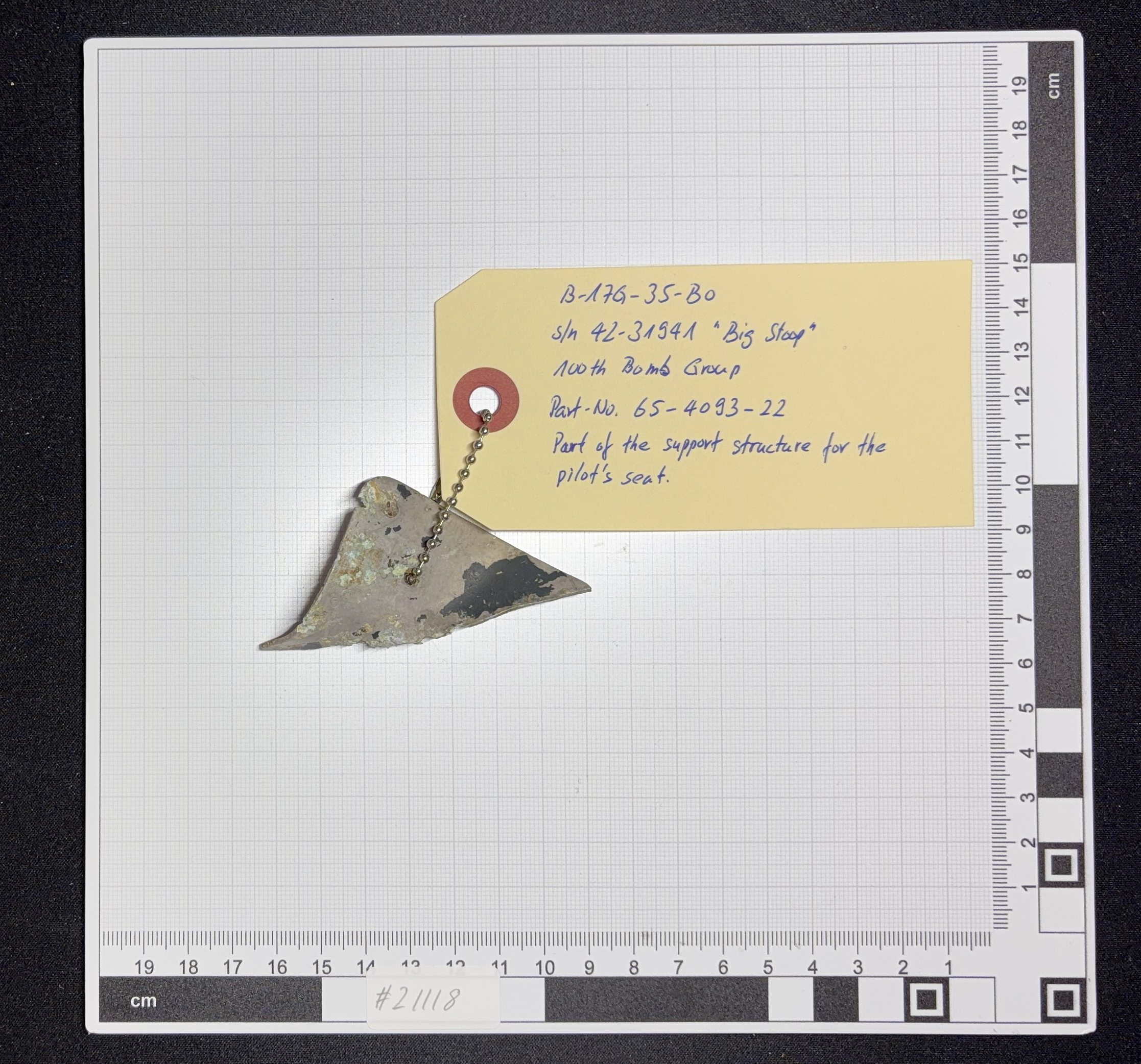
A fragment of a broken channel, which was installed on the pilot’s seat support.
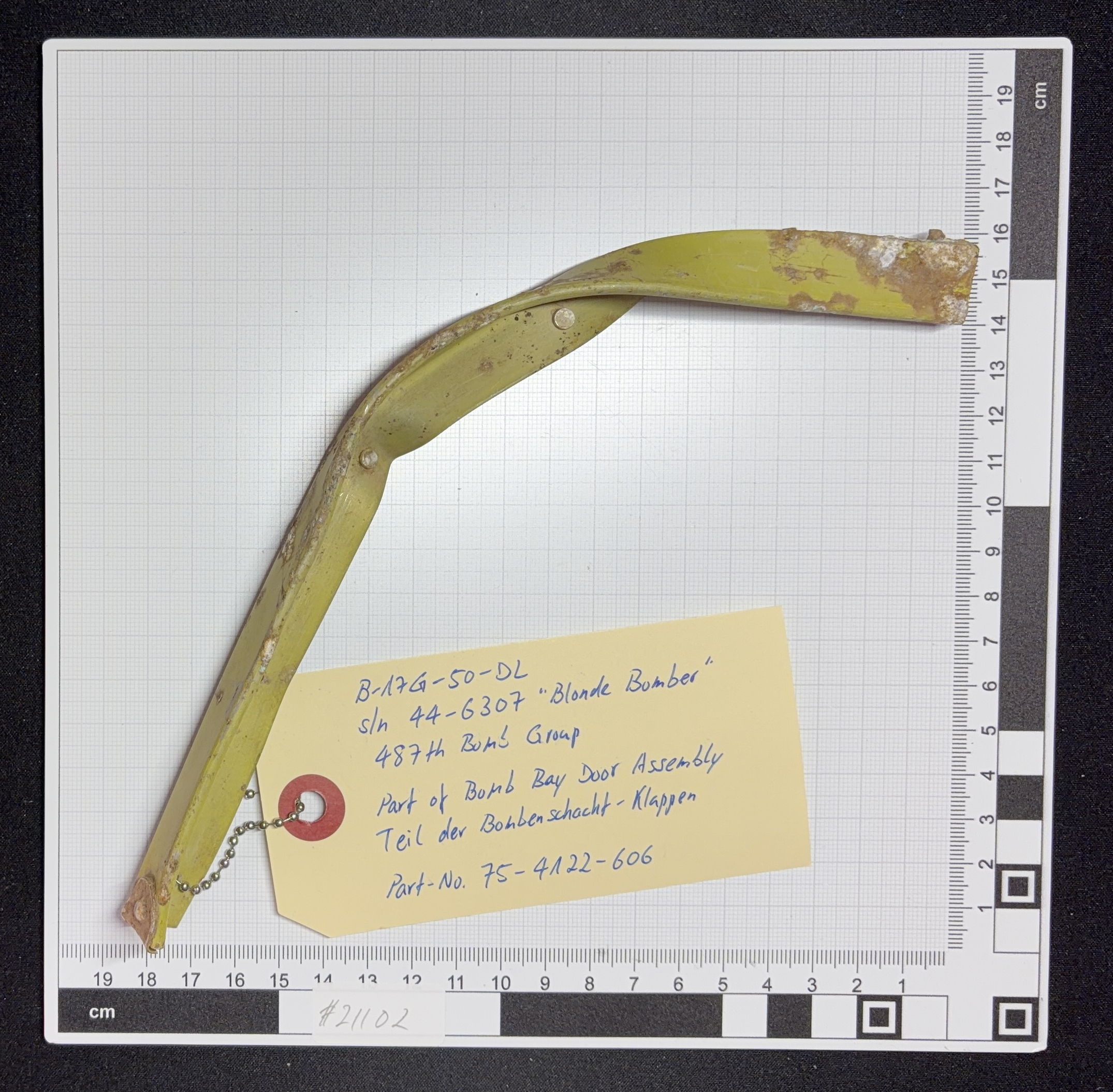
Green stiffener from the left or right bomb bay door of a B-17. It was installed on both, and the part number 75-4122 remained unchanged. It is visibly bent, which makes it difficult to determine the original length. According to the blueprints, the part is 10.44 inches (26.52 cm) long. Three of these stiffeners were installed on each bomb bay door. The part number 75-4122 is visible. Additionally, the digits ‘606’ are engraved. This number indicates that it was installed on the right door. The number ‘376’ is found in another location; its meaning remains unclear.
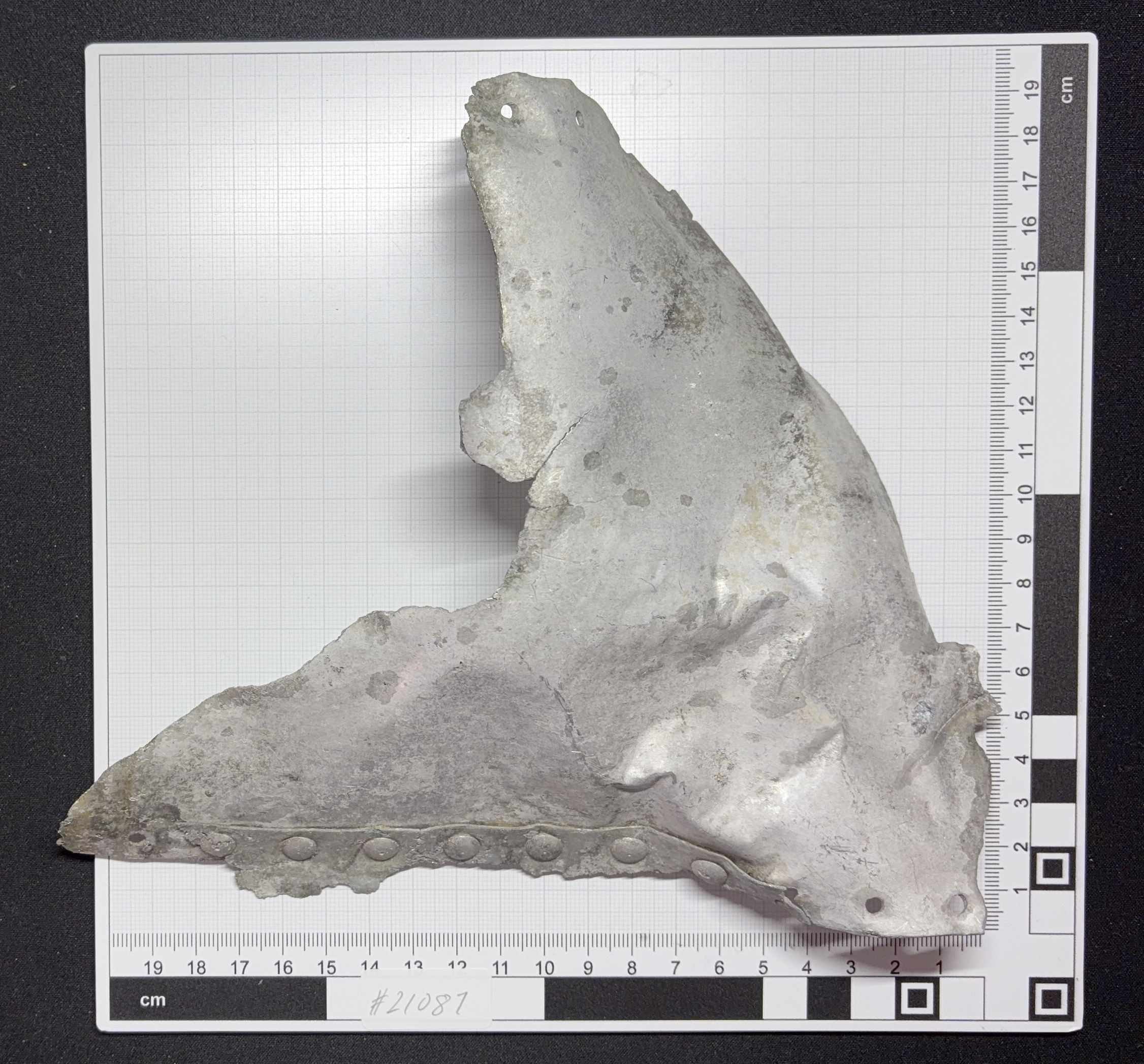
Aluminum fragment. No visible traces of paint or coatings. Approximately 1 mm thick. Seven rivets are visible, as well as four holes/drillings where rivets are missing.
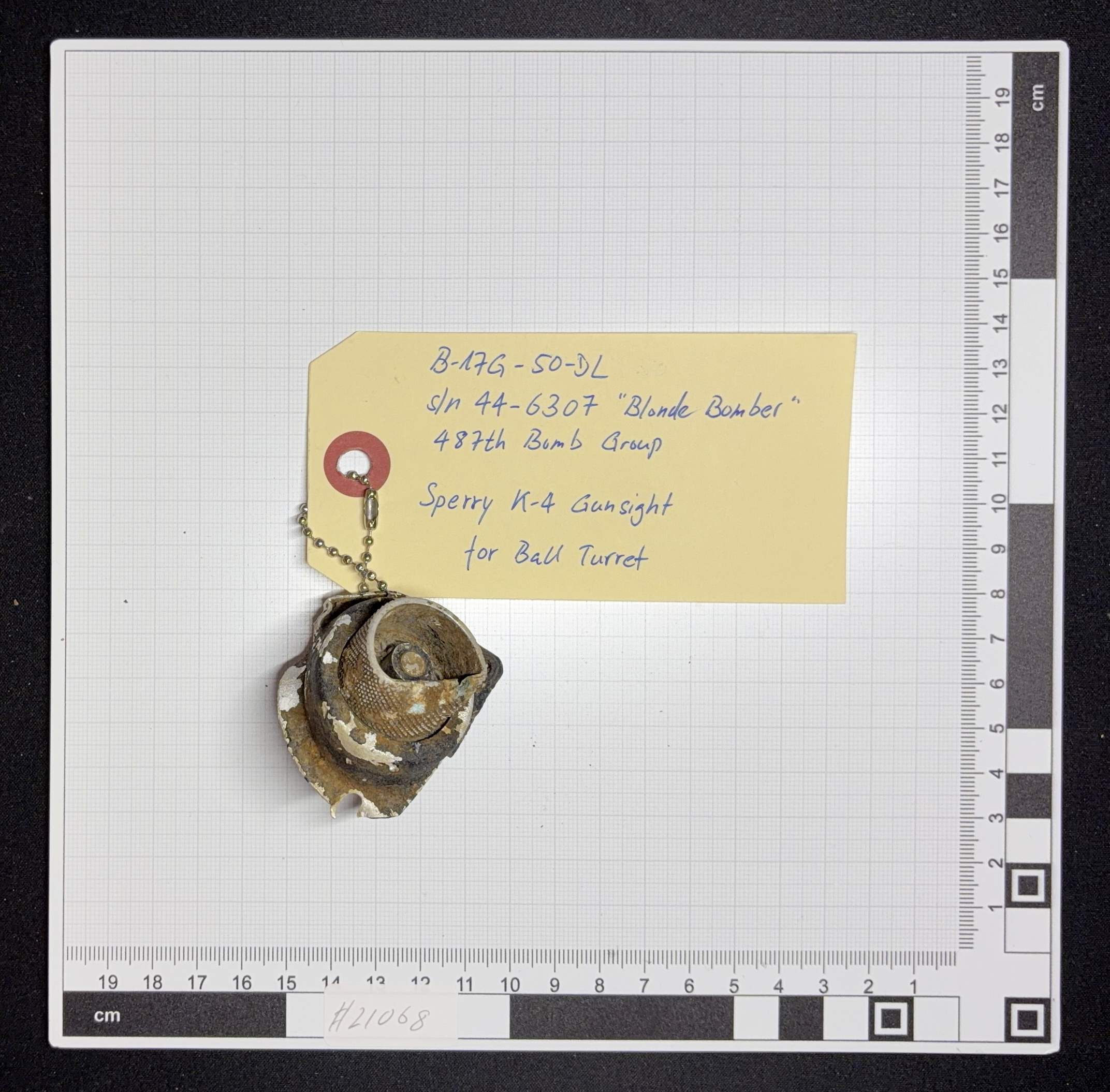
This control knob was installed in the K-4 sight module within the ball turret. It was likely used to adjust the sight according to the target’s wingspan. The inscription ‘Target Dimension Feed’ can be found directly below the knob on the K-4 module.
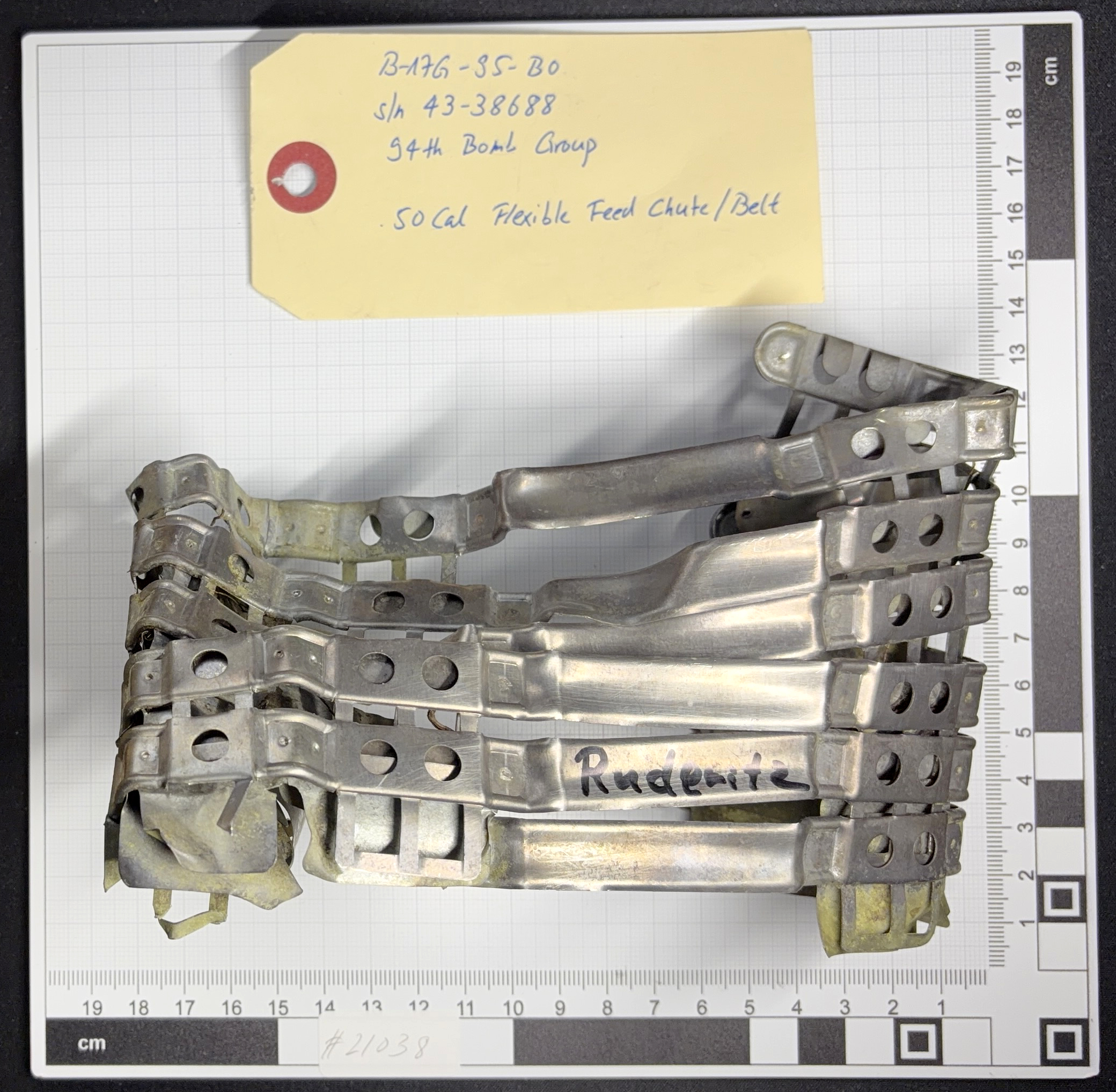
Flexible ammunition feed chute for one of the M2 Browning machine guns. This segment measures approx. 13 cm (approx. 5 1/8″). Compare the thin metal sheets (see below) used in the feed chute.
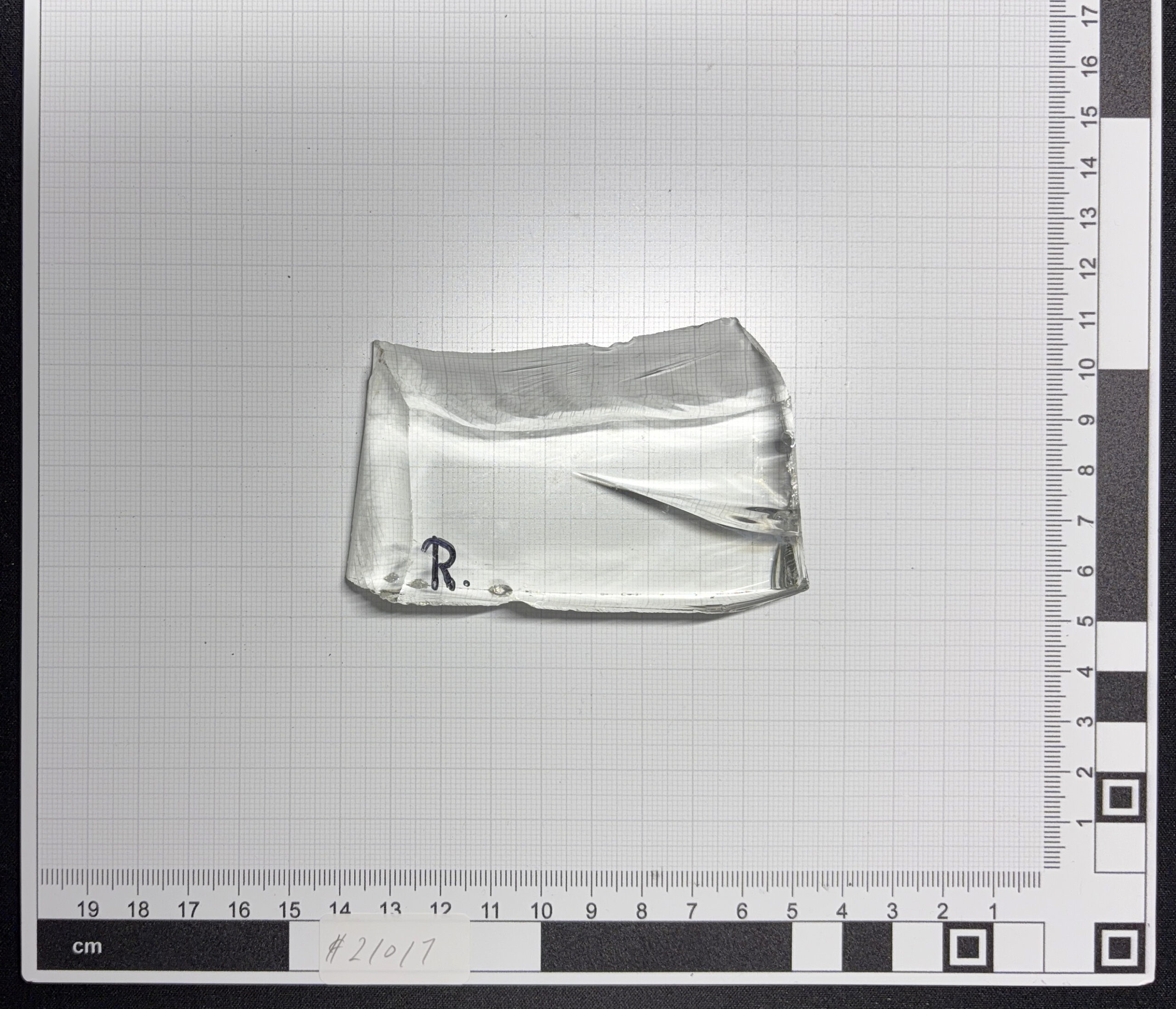
Glass, 20mm (3/4″) thick. Most likely armored or bulletproof glass. Fracture points and crack visible. Note: Tail Gunner’s bullet proof glass is 1.25″ thick (3,175cm)
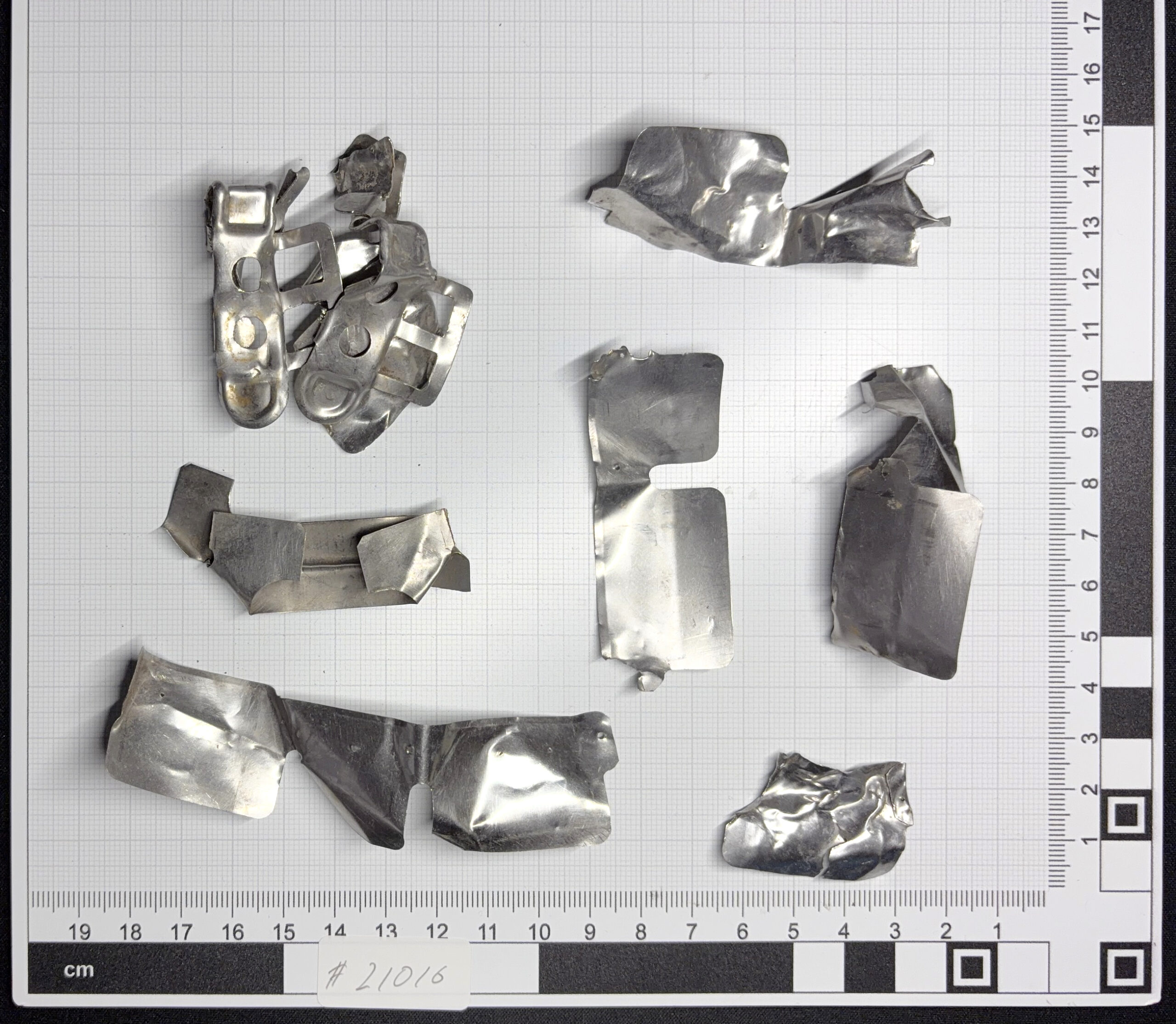
These thin, lightweight metal sheets are part of the flexible ammunition feed chute for the B-17’s M2 Browning machine guns.