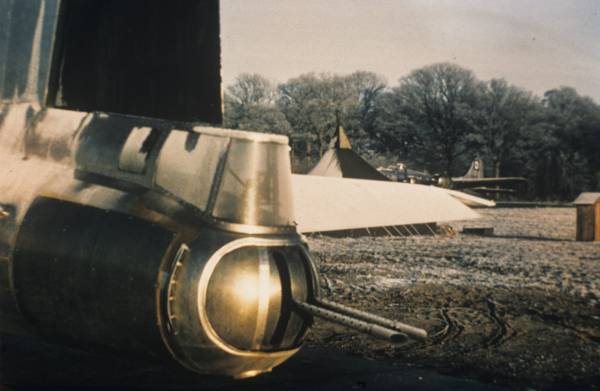
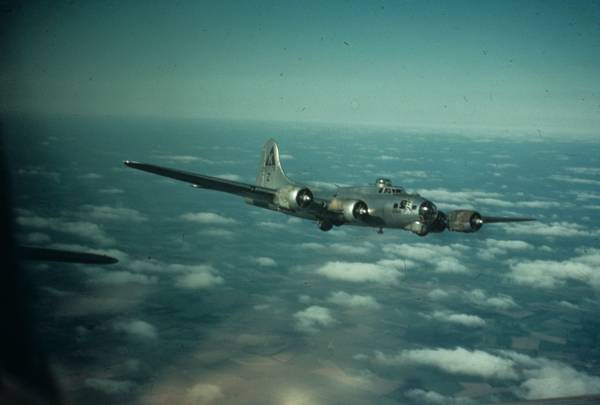
In effect, the B-17G was the B-17F with the powered Bedinx chin turret fitted under the nose section. Design modifications included the Minneapolis-Honeywell electric turbo-supercharger regulators allowing manifold pressure, or boost, to be controlled by one control knob for all four engines. the pilot no longer had to worry about over-revving turbines or having to constantly tweak power controls to stop oil in regulator lines becoming sluggish. Another major difference was that the waist gunners were given anenclosure that protected them from the icy temperatures of high altitude with the position of the guns staggered to give them more room to manoeuvre. The tail gun position was also improved allowing a wider field of fire, a reflector sight, and hand held guns.
However, the new model B-17 also experienced its own operating difficulties. When fired at maximum elevation, the chin turret guns had a tendency to crack the plexiglass nose; a problem was solved by fitting blast barrels to each gun. The oil cooler regulator often failed to operate and could result in complete engine seizure. The ability to feather the propeller blades, in event of engine failture, was lost in the B-17G because the standpipe that held back sufficient oil to work the feathering tank was sacrificed in the quest for a lighter aircraft. This was a major design error and meant that, by the winter of 1943, the lack of feathering was a major reason for bomber loss. Urgent request were made by Groups for special modifications kits but it was only in September 1944 that B-17G’s arrived with these modifications built-in.
Fatal Error
Another serious problem on the B-17G was the lack of an engine fire extinguisher system. Designers had believed that it was ineffective so had left it out of the new model. In reality, the system had worked well and it was requested by Bomber Groups that it be re-introduced as soon as possible.
The B-17G was still tail heavy with the same centre of gravity problems as earlier models. However, by May 1944, when long-range fighter esort was effective defensive protection, gunners were not as busy as before and it was decided that one waist gunner be dispensed with. The radio romm gun, the least used in action, was got also rid of and the quanity of ammunition carried reduced. All these measures brought the centre of gravity nearer th a more acceptable position. In the las month of the war, when there was little enemy fighter activity, some Combat Wings flew without waist guns, ball turrets or chin turrets. Operational reports revealed an estimated 25mph increase in airspeed with the improved streamlining. In this period of the war flak batteries were a greater hazard than fighters and unneccesary gunner armor plate was removed to be replaced with laminated steel and canvas plates called “flak curtains”.
In total, the 8th Air Force received 6,500 B-17G’s. In March 1945, it could send 2,370 of them into combat operations. At the end of the war a total 1,301 B-17G’s had been shot down or reported missing in action.
Delivered Cheyenne 22/8/44; Lincoln 1/9/44; Grenier 11/9/44; Assigned 410BS/94BG Rougham 17/9/44; transferred 34BG Mendlesham 5/45; Returned to the USA Bradley 22/6/45; 4168 Base Unit, South Plains, Texas 24/6/44; Reconstruction Finance Corporation (sold for scrap metal in USA) Kingman 19/12/45. HEAVENLY COMRADE.
Delivered Cheyenne 5/2/44; Kearney 16/2/44; Grenier 25/2/44; Assigned 336BS/95BG [ET-C] Horham 3/3/44; detailed Achmer 5m 8/4/44 with C.S. McCall, Co-pilot: Bob Broderson, Navigator: Phil Mead, Bombardier: (unknown as new on crew), Flight engineer/top turret gunner: Henry Atchue, Radio Operator: Hon Quan Lee, Ball turret gunner: Paul Albert, Waist gunner: Vernon Whalen, Waist gunner: Dan Kinney,Tail gunner: Elmer Connelly, (10 Returned to Duty); o/s RAF Ellough, at Dodd’s Farm, Beccles, Suffolk; Salvaged 12/4/44.
Delivered Cheyenne 24/6/44; Hunter 13/7/44; Dow Fd 23/7/44; Assigned 490BG Eye 26/7/44; Returned to the USA Bradley 12/7/45; 4185 BU Independence 14/7/45; Reconstruction Finance Corporation (sold for scrap metal in USA) Kingman 21/12/45.
Delivered Cheyenne 18/7/44; Kearney 28/7/44; Grenier 8/8/44; Assigned 751BS/457BG [N] Glatton 10/8/44; in base landing accident with Lorenz Koch 2/5/45; Returned to the USA Bradley 9/6/45; 4168 Base Unit, South Plains, Texas 14/6/45; Reconstruction Finance Corporation (sold for scrap metal in USA) Kingman 10/12/45. LIBERTY BELLE.
Delivered Denver 18/1/44; Cheyenne 23/1/44; MacDill 6/2/44; Morrison 8/3/44; Assigned 815BS/483BG Tortorella 13/3/44; one of two aircraft conducted secret mission to Czechoslovakia on 17/9/44, with supplies to resistance and returning with US evadees; Salvaged 30/4/45. PAPER DOLL.
Delivered Cheyenne 12/3/44; MacDill 29/3/44; 326 BU MacDill 14/2/45; 330 BU Dyersburg 5/3/45; 328 BU Gulfport 19/5/45; 3704 BU Keesler 23/5/45; 330 BU Dyersburg 11/9/45; Reconstruction Finance Corporation (sold for scrap metal in USA) Walnut Ridge 19/12/45.
Delivered Hunter 20/12/44; Dow Fd 6/1/45; Assigned 836BS/487BG Lavenham 8/1/45; Returned to the USA Bradley 10/7/45; Reconstruction Finance Corporation (sold for scrap metal in USA) Kingman 21/12/45.
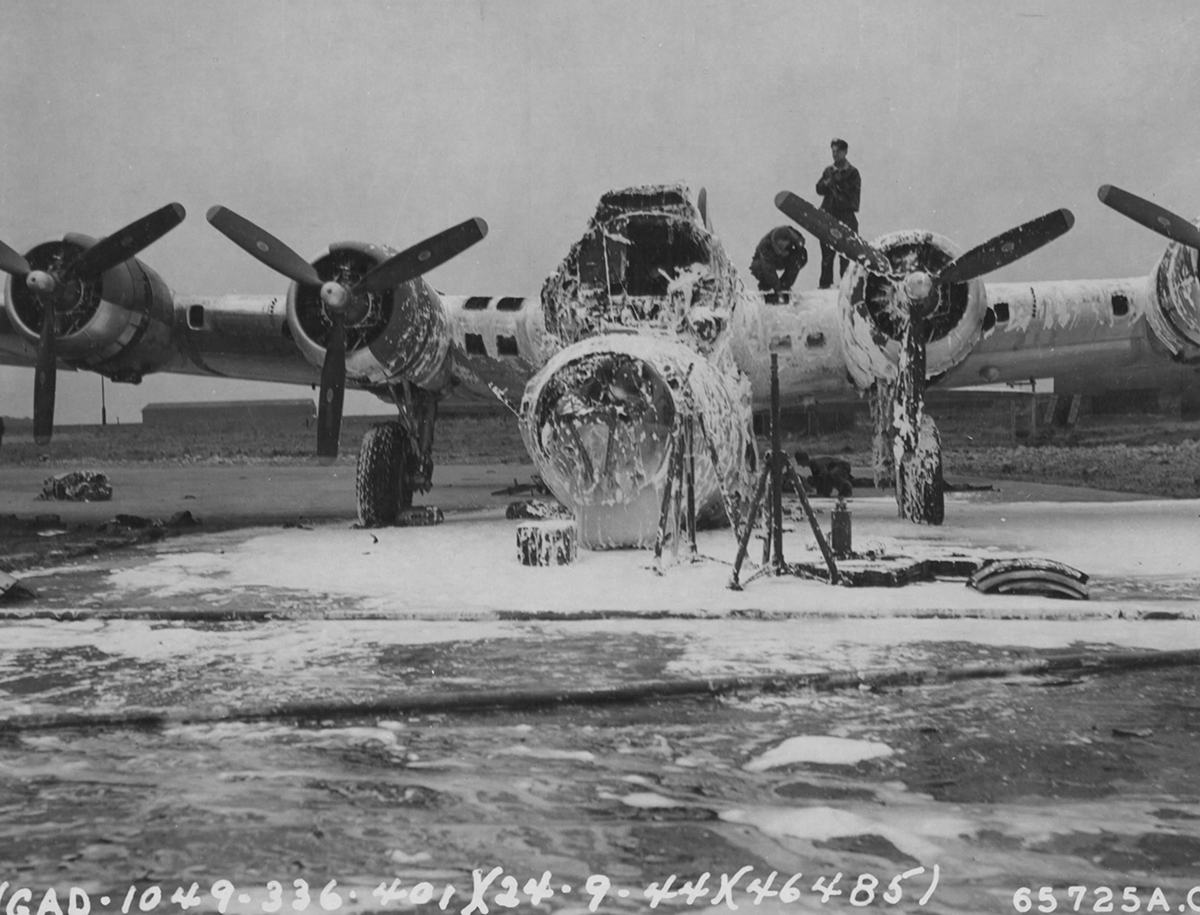
Delivered Hunter 19/8/44; Dow Fd 3/9/44; Assigned 612BS/401BG [IY-X] Deenethorpe 23/9/44; during acceptance check by crew chief T/Sgt Tony Donalaio in bomb bay created spark which ignited oxygen and aircraft caught fire in top turret; Salvaged 25/9/44.
Delivered Cheyenne 7/8/44; Lincoln 17/8/44; Grenier 2/9/44; Assigned 708BS/447BG Rattlesden 8/9/44; Missing in Action Kassel 30/12/44 with Bruce Bates, Herb Nachman, George Mixon, Bob Cordell, Jim Toler, Bill Lindsey, Bill Wheeler, Clair Palm, Ben Torre (9 Killed in Action); mid air coll, crashed Stürzenhardt (57km SE of Darmstadt; 57km SW of Würzburg), Germany. Missing Air Crew Report 11240.
Help preserve the archive: I invest a lot of time into these research results. If my work helps you, I would appreciate a small tip!

![B-17G mit Kinnturm // Wikipedia Commons [Public Domain]](https://b17flyingfortress.de/cms/wp-content/uploads/2015/12/B-17G_Nose_in_Detail-762x1024.jpg)