

 zoom_in
Quelle:
www.fold3.com
Produktionsblock:
B-17G-25-VE: 42-97636 bis 42-97735
Hersteller:
Lockheed/Vega
- Bomber-Gruppe:
- 379th Bomb Group
- Bomber-Staffel:
- 526th Bomb Squadron
- RCL: LF-L
MACR: 12217 / KSU/ME/KU: 3646
Einsätze: 127
Geschichte der
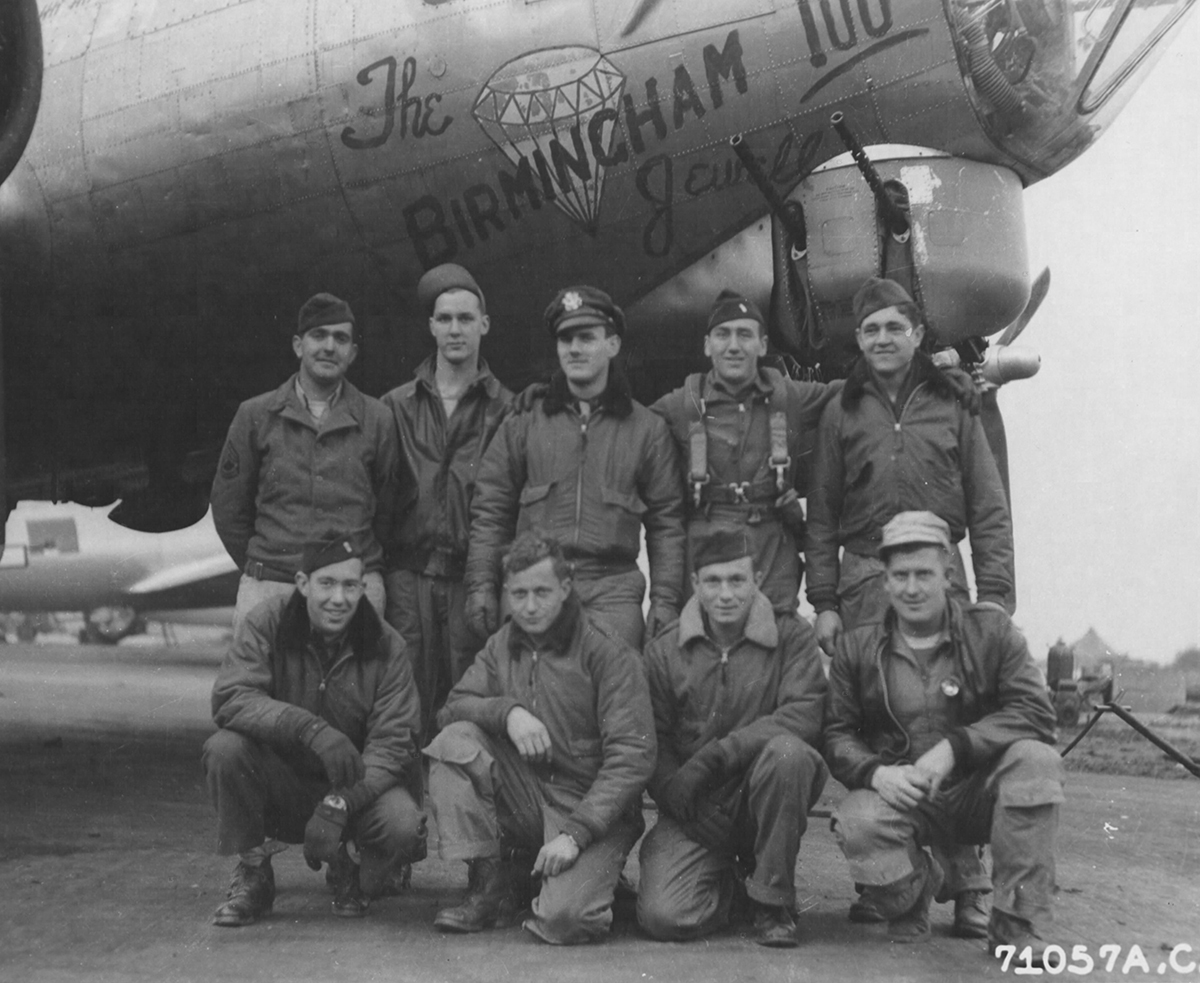
B-17 42-97678 / The Birmingham Jewell
Delivered: Denver 25/1/44; Kearney 15/3/44; Grenier 2/4/44; Assigned: 526BS/379BG [LF-J] Kimbolton 11/4/44; 525BS; MIA Chemnitz {127m} 3/2/45 Pilot: Bill Webber, Ray Weatherbee, Carl McHenry, Bill Wells (4KIA); Jim Kiester, Tom Pickett, Harry Francis, Bill Scarffe, Bennett Howell (5POW); flak, crashed Ilvenstadt, Germany. MACR 12217. THE BIRMINGHAM JEWEL.
Zuletzt aktualisiert: 15. Januar 2026



10. April 2020 access_time 23:55
Your photo: B-17, 42-97678/ Birmingham Jewell, top far rt. is my wife’s uncle: Cecil Loveless, Dover, AR. Survived 30 missions!
12. April 2020 access_time 14:51
Thank you for identification!
11. Mai 2020 access_time 15:50
Top row, 1 in from right, with chut on, is the pilot, my grandfather 2nd Lt. Michael Francis Medinger, picture was right after the successful completion of The Jewel’s 100th mission. Email me for any more info on this plan, I grew up with its history and met the woman for whom it was named.
02. Januar 2026 access_time 6:57
The trip was uneventful and most the men were listening to the BBC radio and were not on the plane’s intercom. We felt we had very little to worry about. We went between Bremen and Hamburg which had accurate flack guns since both cities had been bombed considerably by both the British and Americans. There is a corridor directly between the two cities that the flak guns could not reach. We would, however, have to cross over a German fighter base where Goering’s famous Messersmidt ME 109 were based. The fighter situation for the Germans was pretty well depleted, we felt little concern.
Very shortly after we entered this corridor, two or three ME 109s came in to make a pursuit curve and attacked our plane. The first fighter came in and scored a hit on at least one or two of our engines. The fighter came in at the tail and I could almost see the pilot’s face and he pumped 20 mm cannon shells right into my position. Very fortunately the Birmingham Jewell had been equipped with a special armor plate for the tail gunner. The shells hit on my armor plate, I was not injured,. When it came in I tried to fire my guns but they jammed on a short round. I lifted the cover of my 50 caliber machine gun and removed the short round, so that the gun was ready to fire if and when the ME 109 made another pass. However, it did not make another pass but just watched us. I didn’t understand why it didn’t come in (at first)…
15. Januar 2026 access_time 4:05
I then noticed that we were making some smoke and our vapor trails were turning black instead of the normal blue. As I said, the intercom was not working and I did not hear the bailout bell. I assumed that the crew had used fire extinguishers to put out the fire in the bomb bay and had the plane under control. This was not the case. While back at tail position, I looked behind the tail and saw white puffs of cloud coming out of the plane. It was then I realized that those were not clouds, but my crew bailing out.
I don’t know if I was the last to leave the plane but I do know that I was one of the last. At that moment, I panicked, I undid my oxygen mask and crawled back to put on my parachute which had been hit by the 20 mm cannon. I was only able to snap the parachute on one of the D rings of my chute harness. At that time I was getting anoxia and becoming „woozy“. I was on the verge of passing out. I made my way to the special door for the tail gunner which had some red knobs so that when pulled the door flies off. I was too weak to pull the knobs. I couldn’t get out. I put my weight against the door and got it to swing partially open and I pulled my chute inside the plane. When I pushed the door open, I pulled the parachute ripcord, and the pilot chute opened into the slipstream of the plane. The pilot chute opened the main chute and with force out I came.
Before I had pulled the parachute ripcord I had done a lot of detailed thinking in a matter of moments. I thought it would be very smart if I could delay opening that chute until I got down to about ten thousand feet elevation. I don’t know how I thought I was going to know when I got there, but I was thinking at ten thousand feet where there was more oxygen and I could get rid of my anoxia. This, of course, did not happen.
It took me some 25 minutes to come down. One of the enemy planes that had shot us down came in and made a pass at me but didn’t fire his guns. The pass twisted the cords of the chute and put me into a free fall. Then the pilot chute again reopened the main chute. Two panels on the main chute were damaged and the tears made me come down faster than normal. I had no way of attaching my other D ring to the parachute which was ten feet above me. I was held by a single strap and had no control of the descent. I came down fast. I think the Lord was with me that day because when I landed I didn’t land on the ground, I landed in a tree. Normally this would have been very dangerous but I was unhurt and the trees stopped my progress. I was headed for the ground when all at once, I was airborne again and ended up hanging helplessly in the tree tops. I began working my way from little branches to bigger branches with the idea that I would get low enough to unbuckle the harness and climb down the tree. This was a foolish idea as I would no doubt have fallen out of the tree and injured myself. Luckily, before I could put this plan into action the parachute suddenly broke free of the tree and I came down easily with the parachute canopy over my head, „white like a cloud“. I thought I must have gone to heaven! I soon found out I didn’t.
I buried the chute to avoid capture and decided that I would walk out of Germany. I noticed that my face and my wrists were kind of sore. I had no idea what had happened to them. It was daylight and would be a very poor time for an American airman in flight clothes to be walking around. First, to get out of sight, I found a haystack, dug out part of the hay and got inside the hole. It was February the 3rd, 1945 and Europe was cold, especially in northern Germany.
15. Januar 2026 access_time 4:15
Please correct
Fate: Lost by flak/aa-fire (03 February 1945)
15. Januar 2026 access_time 18:08
I have read the MACR files and changed status so shot down by enemy aircraft.