

 zoom_in
Quelle:
www.studiegroepluchtoorlog.nl
Produktionsblock:
B-17G-75-BO: 43-37874 bis 43-38073
Hersteller:
Boeing
- Bomber-Gruppe:
- 486th Bomb Group
- Bomber-Staffel:
- 834th Bomb Squadron
- RCL: 2S-R
MACR: 11047 / KSU/ME/KU: 3446
Einsätze: 34
Geschichte der
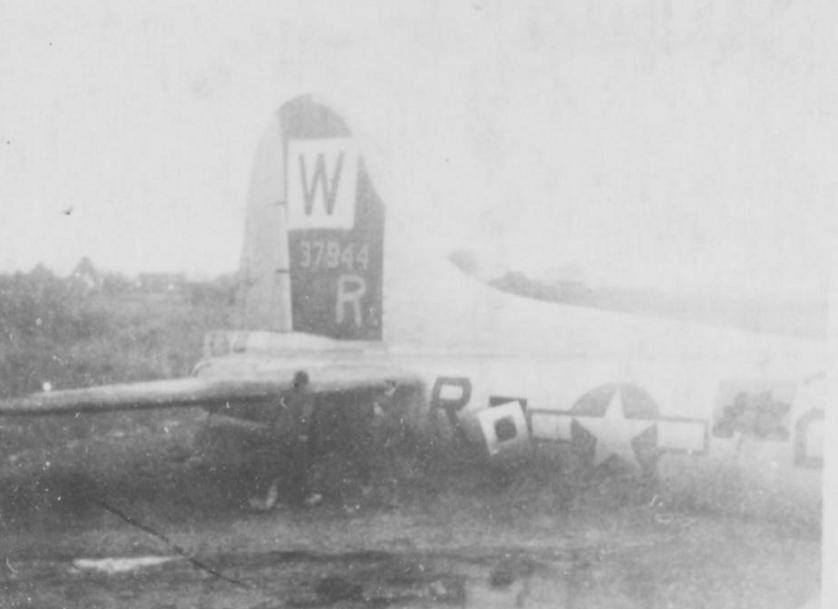
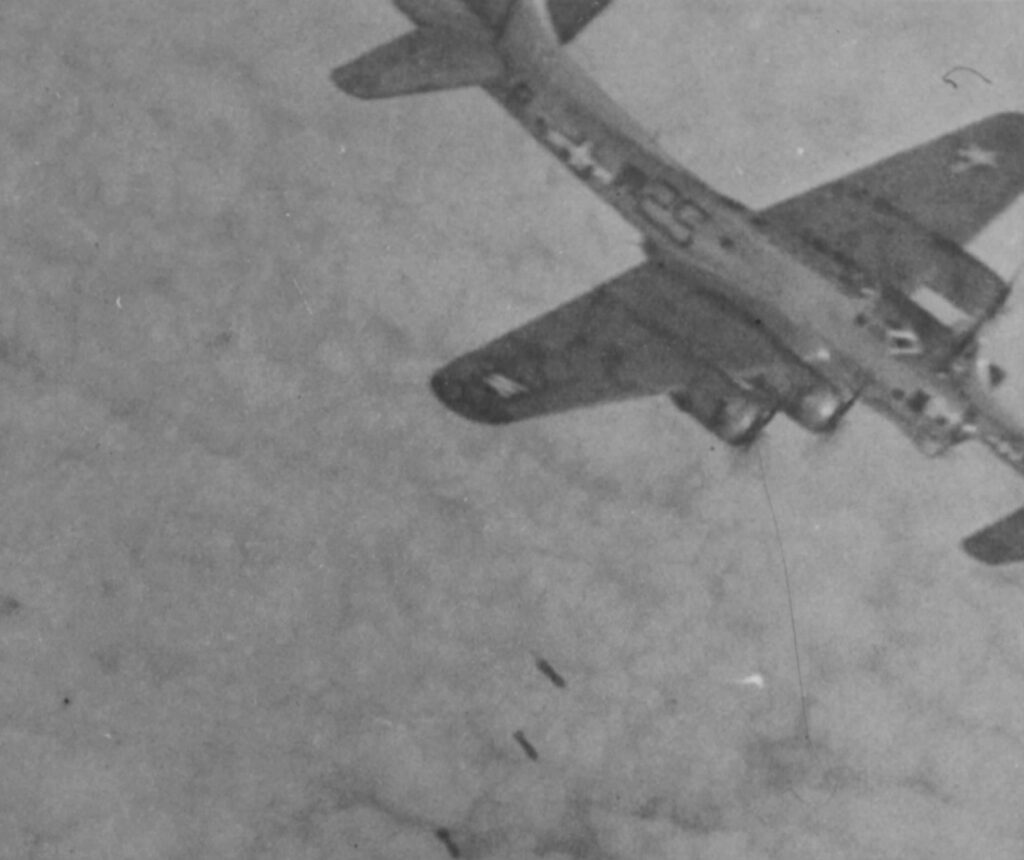
B-17 43-37944 / Mr Tacoma
Delivered Cheyenne 8/6/44; Kearney 20/6/44; Dow Fd 9/7/44; Assigned 834BS/486BG [2S-R] Sudbury 11/7/44; {34m} Missing in Action Merseburg 6/12/44 with Bob Miller, Edmund Barcikowski, Fred Kinsler, Dick Hobgood, Marion Taylor, Bill Effinger, Jim Mathis, Frank Ward, Stan Pavlic (9 Prisoner of War); flak, crashed Uuddorp, Ger. Missing Air Crew Report 11047. MR TACOMA.
Zuletzt aktualisiert: 27. August 2023
B-17 43-37944 / Mr Tacoma Details
Aussagen von Augenzeugen
Lt. Fuscos Crew berichtete, dass sie dieses Flugzeug auf 5149N-1056E in 22000 Fuß Höhe gesehen hat, das Rauch hinter sich herzieht und an Höhe und Geschwindigkeit verliert. Zwei Jäger eskortieren das Flugzeug.
Die Crew von Lt. Lovan sah #944 im Zielgebiet zurückfallen. Es war ein Düppelflugzeug, das 2000 Fuß unter dem Führungsflugzeug flog. Die Flak über dem Ziel war präzise bis ungenaue intensiv Cp- und Sperrfeuer-Flak. Die Besatzung sah #944 zurückfallen und schloss sich nie wieder der Formation an.
Quelle: MACR 11047
B-17 43-37944 / Mr Tacoma Crew
| Position | Rang | Name | Status | Bemerkung |
|---|---|---|---|---|
| P | 2LT | Robert C. Miller | POW | - |
| CP | 2LT | Edmund T. Barcikovski | POW | - |
| NAV | F/O | Fred C. Kinsler | POW | - |
| ENG/TT | T/SGT | Richard M. Hobgood | POW | - |
| RO | T/SGT | Marion W. Taylor | POW | - |
| BT | SGT | William F. Effinger | POW | - |
| WG | SGT | Frank Ward | POW | - |
| WG | SGT | Jim Mathis | POW | - |
| TG | SGT | Stan Pavlic | POW | - |


11. April 2018 access_time 3:40
Thanks ..This helps piece together the story that my Dad and most others from from his generation would not talk about.. Christopher J Kinsler Col. USAF ret
17. August 2020 access_time 13:16
My Uncle Stan was the Tail Gunner As a kid I asked him questions about what it was like? My Aunt told me he would have nightmares after So I didn’t ask anymore
06. Dezember 2022 access_time 5:11
My grandfather, William Effinger, was a gunner on Mr. Tacoma with your dad. If you would like pictures, and more information please contact me. In later years my grandfather told their story and even went to visit the town the plane went down. The town has parts of the plane in a museum and a memorial set up for our family members. We are still on contact with some of the people that made having the memorial possible.
09. März 2021 access_time 21:18
have a look overhere https://db.wingstovictory.nl/database_detail.php?wtv_id=463
15. November 2025 access_time 15:36
By Martin Krey
When Lou Smith pulled the Ex-POW Bulletin out of the mailbox at his Scottsdale home last summer, he had no idea it would lead to a meeting with four men who had shared the most unusual ride of his life, a five-day jostling trip out of the war-torn Germany in a horse-drawn buggy.
Lou Smith served as a B-17 tail gunner in a raid on Berlin on Dec. 5, 1944 that was shot down over Hanover, an industrial city in northwest Germany. Smith’s bomber had lost two of its engines and used all of its radar-disrupting chaff over Berlin, so they had to go down in altitude, and there was no way to mislead the German gunners on their position. They were sitting ducks.
„Those gunners hit us real hard,“ Smith said recently. „And when they got another of our engines, the pilot landed the plane in a potato field. The (plane) broke in two, but luckily nobody was hurt.
„We got out and were quickly faced by surly farmers with pitchforks and rifles. They were mad as hornets, for they thought they had gotten some of the ‚baby killers,‘ which is what they called American airmen. The farmers came at us like they meant to do us in, but they didn’t get a chance, for we had landed dose to a Luftwaffe airfield, and the German airmen came to our rescue.“
The German airmen turned Smith and the rest of the crew over to military police, and after several days of forced marching toward Holland, they were put on a train and headed for Dulag Luft, a prison camp near Frankfort-on-the-Main. They were held there along with hundreds of other Allied soldiers, and a week later they were herded aboard another train with other war prisoners and sent to Stalag Luft 1, a prison camp at Barth, Germany, on the Baltic Sea.
For six months, Smith sat with other prisoners in a barracks, 24 to a room, with nothing to do but wait for the war to end. On May 5, 1945, two days before the German surrender, the Russian army captured Barth and liberated the men in Stalag Luft 1. The German guards were taken away, but the Allied prisoners were told to remain in camp.
„Curiosity got the best of us,“ Smith said ‚We got into the prison office and got our prison camp records, and some of us went on into Barth to see what was going on. We went into the stores and even a bank, and though we could have helped ourselves, we didn’t take anything. There were a lot of dead people lying around, and most of the live ones we saw acted stunned and aloof.“
After several hours in town, Smith and his radio man, Arvid Johnson, and three other airmen came upon a Russian Army group and marched out of town with them toward Rostoc. Stanley Pavlic, a crewman from another downed bomber, could speak Russian, and he talked to the Soviet commander about getting the Americans transportation back to American forces so they could get back to England. A day out of Barth, the Soviet commander shocked the Americans by stopping a German family in a horse-drawn buggy and ordering the family out and Smith and the other four Americans in. Stanley Pavlic and an Oklahoman named Frank Ward knew horses, so they.were told to drive and to head for Wismar and an English battle group five days away.
Off the Americans went, hanging onto the hard boards of the buggy. Once they came upon a large contingent of German troops on the road, but the Germans must have known of the war’s end, for they split to the sides of the road and let the Americans pass without harming them.
Two days on the road, the ex-prisoners all got dysentary, but they kept going, getting food from Russian soldiers along the way and hay for the horse from the Germans. Stanley Pavlic managed the food acquisitions, and Lou Smith used his modest knowledge of German to get what food the horse needed. When the German horse tired, the Americans traded it to the Russians for one of theirs, a beautiful, sturdy and spirited officer’s horse. With this sprightly animal between the traces, the tired cluster of airmen managed to reach Wismar and the British forces. The British gladly took charge of the horse and buggy and flew the five Americans to Kieppe, France, and the American Camp Lucky Strike, a haven for prisoners of war. Several days later, they hitched a ride back to England on an American C-47 cargo plane. Smith’s bomber base had closed down, so he and Arvid Johnson went to an American embarkation center at Southampton and got shipping orders home to the States from Liverpool on a U.S. liberty ship.
Five days later, Smith was back on U.S. soil. He was discharged from the military in December 1945 and spent most of the next 42 years as a mechanic for various airlines, retiring from Northwest Airlines in 1987.
Five years of retirement passed before that issue of the ‚Ex-POW Bulletin‘ led to the reunion of the fliers who had made the horse and buggy journey so many years before.
The ‚Bulletin‘ carried an ad from Stanley Pavlic of Daunesburg. N.Y., saying he would like to hear from any of the ex-prisoners who rode with him in a horse-drawn bum, from Barth to Wismar. He gave his phone number.
„So I called him,“ Lou said, „and by golly it was him, the same guy who had negotiated with the Russians for us after we had gotten out of Stalag Luft 1. We decided to call our crew members and have a meeting.“
Pavlic got hold of Frank Ward in Oklahoma and Bill Effinger in Missouri, and Lou got hold of Arvid Johnson in Deer River, Minn, and they all agreed to meet in Tulsa, Okla., on Sept. 14. They even found Smith’s co-pilot, Noval Covington, in Oklahoma City and got him to the meeting.
At first there was some confusion among the men, trying to recognize each other, but that soon passed, and everybody joined in remembering such things as sleeping in German fields with, cows walking by nd enduring the tortures of traveling. Bill Effinger recalled how a Russian soldier had taken his wrist watch and how the Russian attitude toward the ex-prisoners became severe as they neared Wismar and freedom. Lou Smith wondered what had happened to the German family from whom the Russians had taken the horse and buggy.
The group capped their meeting with banquet and a promise to exchange video tapes and letters and to meet again next year in Indiana.
– – – –
Martin Krey of Scottsdale is a retired teacher.