
Quelle:
www.385thbga.com
| Allgemein | |
|---|---|
| Hersteller: | Boeing |
| Produktionsblock: | , B-17F-100-BO: 42-30332 bis 42-30431 |
| Einsatzgeschichte | |
|---|---|
| Bomber-Gruppe: | , 385th Bomb Group |
| Bomber-Staffel: | , 549th Bomb Squadron |
| RCL: | XA-X |
| MACR: | 2268 |
| Schicksal: |
, Abschuss durch Feindflugzeug (29 Januar 1944) |
Geschichte der
B-17 42-30354 / Hustlin‘ Hussy
Delivered: Cheyenne 23/5/43; Smoky Hill 2/6/43; Gr Isle 3/6/43; Dow Fd 20/6/43; Assigned: 549BS/385BG [XA-X] Gt Ashfield 1/7/43; MIA Frankfurt 29/1/44 Pilot: Ralph Palmer, Navigator: Bill Powell, Engineer / Top Turret Gunner: Art Pacha, Ball Turret Gunner: Leo Reynolds, Waist Gunner: Bill Williams (5POW); Co-Pilot: Ryal Skaggs, Bombardier: Frank Wieczerzak, Radio Operator: Bob Piaroto, Tail Gunner: Elmore Loveland (4EVD); Waist Gunner: Allen Patterson (KIA); Enemy aircraft, crashed Anderlues, six miles NW of Charleroi, Belgium. MACR 2268. SWEET 17 aka HUSTLIN‘ HUSSY.
Informationen können Korrekturen und Ergänzungen auf Grundlage von Jings Recherchen enthalten.
3.541 Aufrufe
Diese Seite wurde zuletzt am 19. Oktober 2018 aktualisiert


10. Juni 2022 access_time 18:52
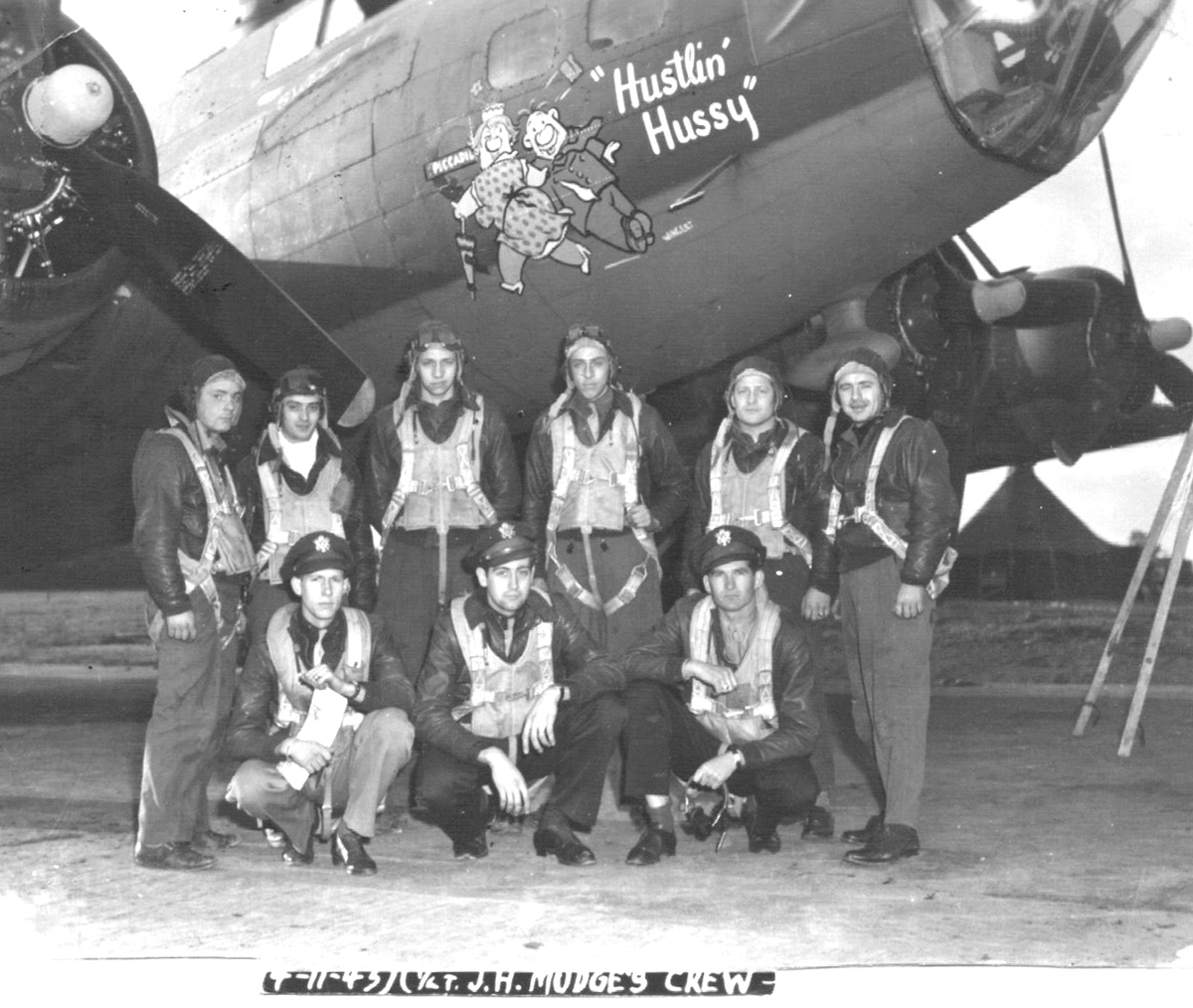
That’s actually the first crew (Jerry Mudge’s crew) in the photo. (my grandfather is second from right in the back row). They finished their 25 missions in mid-late December 1943. The Palmer crew picked up the Hussy after them.
15. November 2022 access_time 5:05
Jerry Mudge is actually my Great Uncle! Going through some old photos, original photos, news articles, editor notes for said articles, patches, a reunion packet, reunion stickers, letters, and a hand written letter/diary right now, can’t figure out who wrote the hand written letter/diary though. However it mentions the names Jim, Freitag, Emmonds, and my Great Uncle LT Mudge. So that eliminates the possibility of one of them writing it. It’s titled, [No.1] Kiel Dec. 13,1943-“Hustlin’ Hussey”. It talks about how they “made it back to the field” after one of their engines went bad during a bombing run in Kiel, Germany. It also states how it was Mudge’s 25th mission. Whoever wrote this states that he envy’s Mudge. This letter/diary entry also gives times like how he woke up at 3:30am, took off at 8am for the bombing run, and made it back to the field at 4pm.
My Great Uncle Jerome “Jerry” Mudge and his brother John Mudge, who flew a spitfire (even during Normandy) , are leading inspirations for myself as I’m interested on going into the Air Force after High School. Cheers.
27. März 2024 access_time 4:20
That’s my dad to the right of Mudge. Bill clark . All great men. Dad would always brought up Mudge in his stories. They were close.
30. Juli 2026 access_time 20:34
My grandpa Richard James Lewis „Dickie“ is 3rd from the left in the back row.
This is something I put together at a dedication ceremony for his 100th birthday
„Grandpa Dick had varied work experience: In the oil fields as a tool dresser with his dad, joined the Civilian Conservation Corps, drafted into the Army Air Corps, was proprietor of a Humble Gas station, joined the U.S. Air Force, taught at ITT, retired but continued to work at odd jobs like Radio Shack in Spencer, Indiana.
In WWII he was a “Sparky”, i.e., Radio Operator/Gunner on B17Fs. His primary ride was the Hustlin’ Hussy, which on one eventful afternoon brought Grandpa and his crewmates back from a raid on Münster with two engines shot out and missing a large part of its tail. He completed his required 25 combat missions, including the horrific October 14, 1943 raid on Schweinfurt when 60 out of 299 B-17s were lost. Grandpa Dick was ahead of the curve with regard to tech’y talent: Instead of heading back to the States to train on B29s for Pacific combat he was given an offer to stay in England with the secret 803rd Provisional Squadron, which focused on Radio Counter Measures (RCM), i.e., tech’y stuff to jam radio transmissions, jam antiaircraft gun laying radar, and to deceive the Germans as to the size and direction of RAF night formations. He crewed his last operational mission July 14, 1944 and then came home on the Queen Mary. We must all understand these were not easy times as indicated by his list of survivor’s decorations: Distinguished Flying Cross, The Air Medal with three bronze Oak Leaf clusters, European-African-Middle Eastern Theater Ribbon with two Bronze Battle Stars, a Reasonable Conduct Medal, and life long reticence about his year in England.
In February of 1950 Grandma Vi and pop caught up with Grandpa Dick in Japan four months before the North Koreans crossed into the South. They lived primarily in Ashiya and Itazuki Japan about 100 miles from Korea. Grandpa worked on maintaining and modifying tube type radio and radar sets that were being cobbled into piston planes, e.g., the ultra cool F82 Twin Mustang, as well as early jets like the F80 Shooting Star. Vibrations from engines and machine guns caused all kinds of problems to tube sets.
In 1953 they went to Albuquerque where Grandpa was introduced to the Armed Forces Special Weapons Project. He spent the rest of his career in Atomic and Hydrogen Bomb maintenance shops (Nukes weren’t particularly reliable and took a lot of tech’y TLC to keep “firing fresh”). In most maintenance shops he was the NCOIC, Non-Commissioned Officer in Charge. He also carried a position title of Nuclear Weapons Superintendant with Top Secret clearance level.
Interesting story of how they ended up in Alaska. Grandpa got court marshaled due to a lack of communication. Under high alert conditions a squadron of B47s scrambled off the Forbes AFB, Kansas runways to dash off to failsafe positions near the Arctic Circle. This was a normal event except the bombers left unarmed. Twenty bombers with a combined total of 120 fuel gulping engines and manned by 60 highly trained and motivated crew of the U.S.A.’s first line nuclear deterrent were circling over the arctic without any bombs. The Air Force took a dim view of this event and Grandpa, as NCOIC, was arrested and brought before charges. Long story short, the culprit in this mess was the squadron commander who, for reasons of religious conscience, didn’t pass down the order to arm the planes and then tried to cover up the omission by implicating Grandpa. The squadron commander got sent to a loony bin, and they got a visit from the Commander of SAC, General Power, and ex-Commander, General Curtis LeMay. Even though Grandpa was totally acquitted and given high praise for his professionalism enduring the proceedings, the Generals told Grandpa he couldn’t stay in Kansas and was asked where he would he like to go. Grandpa said, “Alaska” and within two weeks they were on the road to Eielson AFB near Fairbanks. They left Kansas the 6th of December and 3,600 miles later, mostly in sub-zero temperatures; they pulled into Eielson AFB Christmas Eve. (They arrived late in the day, but the base commander had the PX-opened up so Grandpa could do some Xmas shopping.)
In 1964 after a second court martial for which he was once again acquitted, Grandpa had his fill of the Air Force and retired after twenty years in kaki and blue. He was given the Air Force Commendation Medal at his retirement ceremony.
Then there was the divorce in 1966 followed by marriage to Leona Goins. Grandpa, Leona, and Gram (great grandma) moved from Peru, Indiana to Indianapolis, and he began teaching at Howard W. Sams Technical Institute, which evolved into ITT Tech.
He retired from ITT and moved to his hilltop south of Spencer in Sweet Owen County. With his mother near at hand in a cabin he built for her in the woods, he raised a series of annoying goats, and played in his not inconsiderable garden.
Leukemia got him. It was likely triggered from years of goof’n with fissionable materials in the bombs. He was also at a detonation in Nevada where he got pelted by blast debris, which is entirely too close to be safe. I can state with little or no fear of contradiction that Grandpa was a Cold War Casualty.
He is buried in Myrtle, PA near where he was born. After hundreds of thousands of miles traveled, he is back where he started.“
22. Februar 2026 access_time 22:35
I worked for Co-Pilot Ryal Skaggs for a couple of years while I was in high school. One day he opened up and told me about the flight in which the B17 was shot down. I was very interested in the story but, I was 17 years old and didn’t follow up and ask a lot of questions. I have wished a million times that I had followed up on his story. He said when they flew out on their bomb run the clouds were at 5,000 ft. and they were flying at 10,000 ft. On their way back and it was evident that they were going to have to bail out, he did not pull his rip cord until he fell thru the clouds because at the time, German pilots were shooting pilots in their chutes. He landed in a field where locals were working and they helped hide him until he could make his escape backs to friendly lines.