

Quelle:
www.fold3.com
| Allgemein | |
|---|---|
| Hersteller: | Lockheed/Vega |
| Produktionsblock: | , B-17G-25-VE: 42-97636 bis 42-97735 |
| Ausgeliefert: | Denver |
| Einsatzgeschichte | |
|---|---|
| Bomber-Gruppe: | , 379th Bomb Group |
| Bomber-Staffel: | , 526th Bomb Squadron |
| RCL | LF-L |
| MACR | 12217 |
| KSU/ME/KU: | 3646 |
| Schicksal: |
, Abschuss durch Feindflugzeug (03 Februar 1945) |
| Einsätze: | 127 |
Werbung/Advertisement
Geschichte der
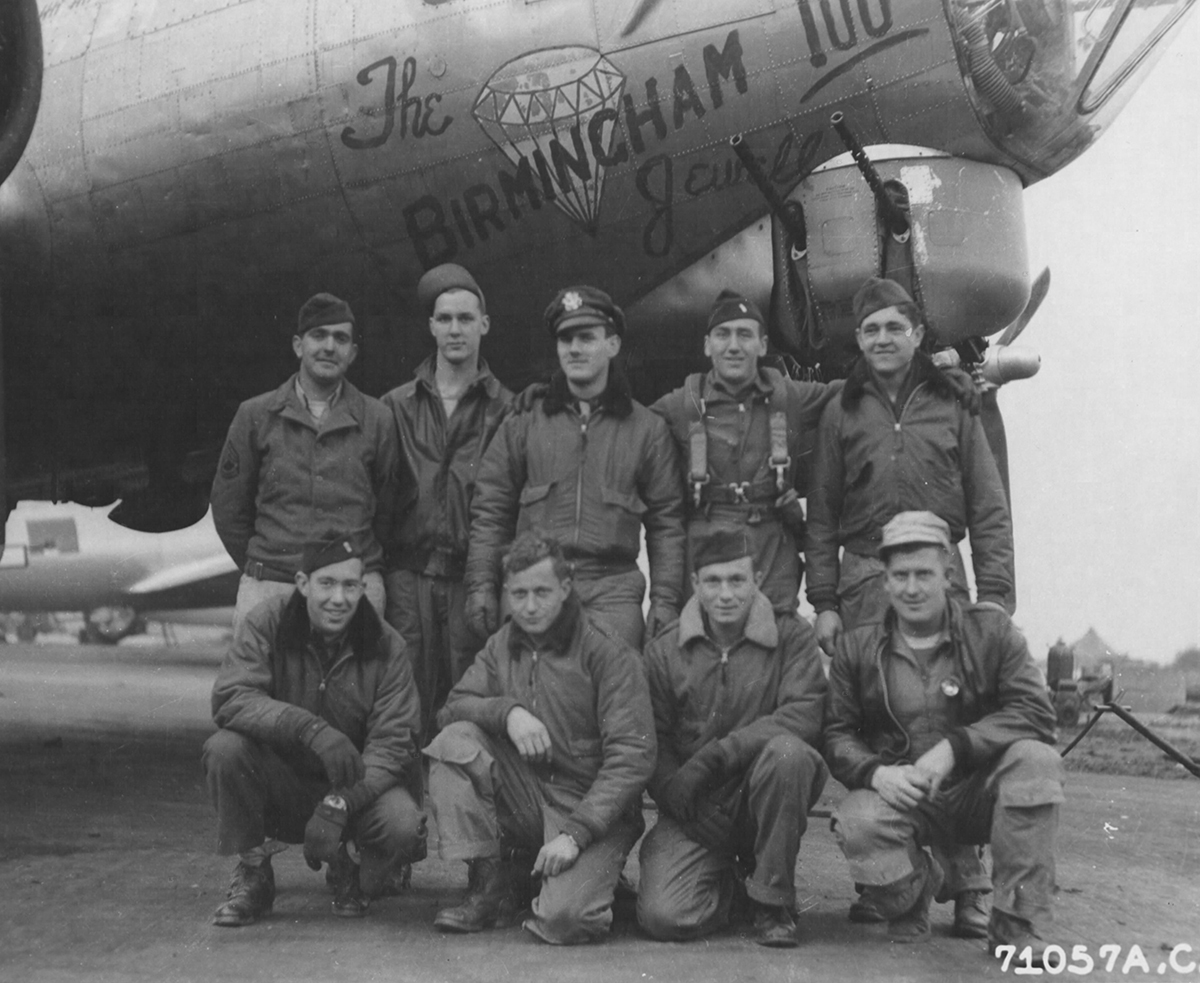
B-17 42-97678 / The Birmingham Jewell
Delivered: Denver 25/1/44; Kearney 15/3/44; Grenier 2/4/44; Assigned: 526BS/379BG [LF-J] Kimbolton 11/4/44; 525BS; MIA Chemnitz {127m} 3/2/45 Pilot: Bill Webber, Ray Weatherbee, Carl McHenry, Bill Wells (4KIA); Jim Kiester, Tom Pickett, Harry Francis, Bill Scarffe, Bennett Howell (5POW); flak, crashed Ilvenstadt, Germany. MACR 12217. THE BIRMINGHAM JEWEL.
Informationen können Korrekturen und Ergänzungen auf Grundlage von Jings Recherchen enthalten.
Werbung/Advertisement
Diese Seite wurde zuletzt am 15. Januar 2026 aktualisiert
10. April 2020 access_time 23:55
Your photo: B-17, 42-97678/ Birmingham Jewell, top far rt. is my wife’s uncle: Cecil Loveless, Dover, AR. Survived 30 missions!
12. April 2020 access_time 14:51
Thank you for identification!
11. Mai 2020 access_time 15:50
Top row, 1 in from right, with chut on, is the pilot, my grandfather 2nd Lt. Michael Francis Medinger, picture was right after the successful completion of The Jewel’s 100th mission. Email me for any more info on this plan, I grew up with its history and met the woman for whom it was named.
02. Januar 2026 access_time 6:57
The trip was uneventful and most the men were listening to the BBC radio and were not on the plane’s intercom. We felt we had very little to worry about. We went between Bremen and Hamburg which had accurate flack guns since both cities had been bombed considerably by both the British and Americans. There is a corridor directly between the two cities that the flak guns could not reach. We would, however, have to cross over a German fighter base where Goering’s famous Messersmidt ME 109 were based. The fighter situation for the Germans was pretty well depleted, we felt little concern.
Very shortly after we entered this corridor, two or three ME 109s came in to make a pursuit curve and attacked our plane. The first fighter came in and scored a hit on at least one or two of our engines. The fighter came in at the tail and I could almost see the pilot’s face and he pumped 20 mm cannon shells right into my position. Very fortunately the Birmingham Jewell had been equipped with a special armor plate for the tail gunner. The shells hit on my armor plate, I was not injured,. When it came in I tried to fire my guns but they jammed on a short round. I lifted the cover of my 50 caliber machine gun and removed the short round, so that the gun was ready to fire if and when the ME 109 made another pass. However, it did not make another pass but just watched us. I didn’t understand why it didn’t come in (at first)…
15. Januar 2026 access_time 4:05
I then noticed that we were making some smoke and our vapor trails were turning black instead of the normal blue. As I said, the intercom was not working and I did not hear the bailout bell. I assumed that the crew had used fire extinguishers to put out the fire in the bomb bay and had the plane under control. This was not the case. While back at tail position, I looked behind the tail and saw white puffs of cloud coming out of the plane. It was then I realized that those were not clouds, but my crew bailing out.
I don’t know if I was the last to leave the plane but I do know that I was one of the last. At that moment, I panicked, I undid my oxygen mask and crawled back to put on my parachute which had been hit by the 20 mm cannon. I was only able to snap the parachute on one of the D rings of my chute harness. At that time I was getting anoxia and becoming „woozy“. I was on the verge of passing out. I made my way to the special door for the tail gunner which had some red knobs so that when pulled the door flies off. I was too weak to pull the knobs. I couldn’t get out. I put my weight against the door and got it to swing partially open and I pulled my chute inside the plane. When I pushed the door open, I pulled the parachute ripcord, and the pilot chute opened into the slipstream of the plane. The pilot chute opened the main chute and with force out I came.
Before I had pulled the parachute ripcord I had done a lot of detailed thinking in a matter of moments. I thought it would be very smart if I could delay opening that chute until I got down to about ten thousand feet elevation. I don’t know how I thought I was going to know when I got there, but I was thinking at ten thousand feet where there was more oxygen and I could get rid of my anoxia. This, of course, did not happen.
It took me some 25 minutes to come down. One of the enemy planes that had shot us down came in and made a pass at me but didn’t fire his guns. The pass twisted the cords of the chute and put me into a free fall. Then the pilot chute again reopened the main chute. Two panels on the main chute were damaged and the tears made me come down faster than normal. I had no way of attaching my other D ring to the parachute which was ten feet above me. I was held by a single strap and had no control of the descent. I came down fast. I think the Lord was with me that day because when I landed I didn’t land on the ground, I landed in a tree. Normally this would have been very dangerous but I was unhurt and the trees stopped my progress. I was headed for the ground when all at once, I was airborne again and ended up hanging helplessly in the tree tops. I began working my way from little branches to bigger branches with the idea that I would get low enough to unbuckle the harness and climb down the tree. This was a foolish idea as I would no doubt have fallen out of the tree and injured myself. Luckily, before I could put this plan into action the parachute suddenly broke free of the tree and I came down easily with the parachute canopy over my head, „white like a cloud“. I thought I must have gone to heaven! I soon found out I didn’t.
I buried the chute to avoid capture and decided that I would walk out of Germany. I noticed that my face and my wrists were kind of sore. I had no idea what had happened to them. It was daylight and would be a very poor time for an American airman in flight clothes to be walking around. First, to get out of sight, I found a haystack, dug out part of the hay and got inside the hole. It was February the 3rd, 1945 and Europe was cold, especially in northern Germany.
15. Januar 2026 access_time 4:15
Please correct
Fate: Lost by flak/aa-fire (03 February 1945)
15. Januar 2026 access_time 18:08
I have read the MACR files and changed status so shot down by enemy aircraft.
16. Januar 2026 access_time 18:10
The hay was warm and I was hidden and I went to sleep and slept soundly. When I awoke I got my escape kit which was a normal part of airman’s equipment, and looked for maps to find my location. I also found some caffeine pills which would provide energy for some time. I found that I had maps of Africa, northern France, southern France, Italy and not one of Germany. So the maps did me no good. I located the North Star, and from that I headed in a northerly direction to get to Denmark. I took most of the caffeine pills which gave me energy and kept me awake for several days. By that time, my face was starting to be very painful. I walked for several hours seeing no one. Then I came upon a small town. My attitude was depressed „so what the heck“. I walked straight through the town. People were walking on the street. Nobody looked at me, nobody stopped me, nobody seemed to notice me at all. Added to the strangeness of my appearance I didn’t have on any shoes. The electrically heated felt shoes that came with my flying boots were still on. The flying boots must have come off when I left the plane. I walked most of the night and when I was tired I found another haystack and crawled in. I slept rather poorly because of the caffeine pills and stayed in the haystack throughout the daylight hours. In the evening, I began walking again. By then I realized that my face was very badly burned and white pus was beginning to cover it and my eyes were swelling shut. After walking a short way further, I remembered the intelligence briefing telling us that if we were shot down we could probably get help at a local farmhouse outside a town and be treated well, perhaps even the farmer would allow me to escape back to England. I picked out a farmhouse and knocked on the door. I must have looked at sight, my face, full of pus, eyes swollen, and in a flying suit. The farmers brought me into the house and sat me in a chair. They had been playing cards of some kind. They immediately called the German People’s Army. I was picked up and I was a Kriege.
I was taken to Jevenstedt, a county jail, or a first aid station. I can’t remember much because I was in pain. The German doctor put something under my arm to diminish the pus and then bandaged my face and hands with papiermache bandages, something which I was to regret later. I was placed next to another one of my crew, who I later learned was Waist Gunner S/Sgt Scarffe. He had been hit in the back by a 20mm cannon shell shrapnel on the enemy planes first attack. He realized that his only hope was to get medical aid, so he bailed out. I don’t remember much about that first day.
The second day they put me on a train and sent me with the rest of the surviving crew, except Scarffe, to an interrogation center at a place that sounded like Frankibint. I was accompanied by the navigator 1st Lt. Thomas A. Pickett. I had my head wrapped with paper bandages and looked a sight and was slightly delirious, and talked all the time in English. The passengers on the train resented an American bomber crewman jabbering in English and they threatened to kill me. We were transferred to the train baggage department. Another interesting remark I started flying on December 24, 1944. My first missions were to stop supplies from going to the Bulge by bombing the bridge on the Rhine at Cologne. The train ride to the interrogation center crossed the bridge that we were supposed to have eliminated several times.
At Frankibint, I was put in a cell measuring about 8 feet by 6 feet with a straw bed and a radiator. On the radiator was a sign reading „Any POW tampering with the radiator will cause all POWs to go without heat.“ It also said to „knock for aid if you wanted to go to the bathroom“ and on the bottom was the phrase „Kilroy was here“. I stayed in that cell for a couple of days. I talked to no one. I asked to be taken to the bathroom a couple of times, the German who took me there didn’t understand English and I sure didn’t understand him.
About the second or third day, I was taken to an interrogation officer. It was a practice for the German interrogator to speak the prisoner’s language and hold his equivalent German rank. He was a German sergeant, same as I. He spoke excellent English and said he was from Chicago, my hometown. How thy knew where my hometown was, I don’t know. They had evidently done a lot of research before I went in for interrogation. He knew all teh places down Halstead Street, he knew the bars, he knew the singers in the local joints. He knew places that only I, as a special delivery mail carrier before going in the army, would know, he knew everything in great details. He knew where my home area of Beverly Hills was. He knew all the parks that I knew and had grown up near. After finding out that I didn’t know anything, which I’m glad I didn’t, he said that he would help by sending me to a local hospital.
This hospital had no doctor, only British medic, and it was administered by the Germans. There were triple bunk beds and I was put in a room of burn patients. Anyone who knows anything about burns, knows that they stink. And I’m on the top bed, so it „stunk, stunk, stunk“ from all the other burn patients. Everybody stunk, including me. I choked and couldn’t sleep. The next day, the medic brought in hot water and soaked off my bandages taking off as little skin as possible. I stayed there about one or two days. I don’t remember much, but all of the time I was hearing the artillery guns. General Patton’s Third Army was either at the Siegfried Line, crossing it or somewhere close.
18. Januar 2026 access_time 1:20
They decided to move the hospital to Obermasfeld & Meiningen. Every one in the Frankenbit Hospital was put on a bus which was fueled by charcoal, and traveled on the autobahn to the new hospitals. Obermasfeld was a hospital and Meiningen a recuperation center with just ward nurses. At Obermasfeld I met a Captain Holden, who was in the British army and had been captured in North Africa. He was one of the foremost dermatologist and plastic surgeons in the United Kingdom. He told me that if he could operate now and put skin grafts on my burns that I wouldn’t be scarred for life. And so he did. No anesthetic or anything else. They operated and took the skin from my butt, tied me to a bunk so that I couldn’t touch the wounds and just let me yell. I don’t remember how long I stayed there, but after several days I was sent to Meiningen.
Meiningen prison hospital was in an old theater that belonged to Prince Meiningen. It was very cold with no heat. I didn’t know exactly where in Germany I was, but think I was in central Germany. I was put in a kind of outbuilding which had a stove, but no fuel for it. They allowed the prisoners to sift through the ashes from the power plant and pick up any unburned material. We spent several hours a day doing this. Our food was brought to us and it consisted of some grass soup and a loaf of bread. Each prisoner got a bowl of soup and an eighth of the loaf of bread. It was German dark bread made, from rye, acorns, maybe sawdust, it was very heavy bread. A loaf would weigh anywhere from four to five pounds. At that time we were all losing weight and we were all hungry. Each man in the hut took a turn distributing the soup and the bread. The distributor cut the loaves as evenly as he could so that each POW got an eighth and the man cutting it was the last to pick his eighth, however he did get the bread crumbs. We got Red Cross parcels from the Swiss Red Cross which contained cigarettes. Klim which is a powdered milk, bitter chocolate bars and cans of food like meat, beans, etc. It was very good but once you opened the can, which was more than you could eat at one time, you had a hard time preserving it. So we would share cans between us and leave some cans unopened for later.
In the hut in Meiningen there were British, Scots, Canadians and American POWs. Most of us couldn’t understand each other. I could not understand the Scotsmen no matter what. The Canadians couldn’t understand them either. The Americans got along fine with the Canadians but even the Canadians speak a bit differently than we do. We played poker for cigarettes and still lucky, I had a lot of cigarettes. This turned out to be very valuable because I could later trade them to the German people for food. An interesting sideline when in a US barrack the men usually talked about women, but as a Kriege the talk was about the wonderful sundae, or some other dessert that we had before going overseas. When hungry your mind turns to food.
While we were there we heard General Patton’s Third Army guns firing again. You could hear the reports and the returning reports and you knew that the war was coming our way. There was a high wire fence around the whole compound and a single little trip wire ten feet inside the wire fence. If anyone was caught in between the main wire and the trip wire they would be shot. So it was virtually impossible to escape, especially since most of us had some injuries and wanted to stay close to medical attention. I don’t remember anyone ever trying to escape. Also, while we were there, there were several air raids and they would put us down in the basement of the theater, which was their air raid shelter. We would sit down there amongst the mice and rats. We killed and ate them. One time during an air raid, a horse was killed and when it was brought into the camp we ate it. That may sound disgusting but with the state of our hunger we didn’t care.
One day the German officials came into the barracks and called out the names of everyone who could walk. They put us on a train to Nurnberg Stalag XII-D. Hitler was always trying to keep us from being liberated. We cot on this train and within a few hours there was an air raid. Of course the American planes didn’t know who was in the train, the Germans just locked the doors of our boxcars and left us inside while the Americans strafed our train. We lost several of the prisoners in our boxcar and I don’t know how many were lost on the whole train.
When we got to Nurnberg, the camp was large and held several thousand prisoners of all nationalities. The facilities were crowded and all new arrivals lived in a type of circus tent. They gave each one of us a place to keep our belongings which was about 12 inches wide and 6 feet long. It was very, very crowded. I met some Serbian Generals who spoke good English. They were in the cavalry and they had charged with their swords drawn against Hitler’s tanks. They were turned back and captured. They had been prisoners ever since Hitler entered Serbia. I stayed in Nurnberg for about a week and then we were told that we were going to Stalag VII-A at Moosburg which was about 140 miles from Nurnberg.
We were told that we could go by train or walk, all prisoners chose to walk. The first day we walked about 15 km but there was no place to bed us down, so we walked back about 5 or 6 km where they put us in a church. The church was cold and damp with no heat. It had rained that day and we were all cold and wet lying between the pews in that church trying to sleep. The total trip took about a week to get to Moosburg. The second day the American planes strafed railroad box cars in a marshaling yard close to the prison columns. I hid behind railroad ties in the marshaling yard and did not get hurt. At that time the prisoners got some sand and wrote POW in a big field along our column. The planes flew over again, recognized the signal and dipped their wings back and forth in acknowledgement. And from that time on the column had air cover for the remainder of the trip. We had no more worry of American planes strafing us.
The walk was kind of interesting. The war was almost over and Germany knew that they had lost. The guards were all Polish and I don’t know how they got into the German army, not knowing Polish, I couldn’t speak to them. They were not at all hostile, but were very friendly and in some instances, when they would get tired, some prisoner would help them out by carrying their rifle. At this time there was formed what I called our „six some“. These were six men, all of whom had developed some kind of skill that would enable us to live a little bit better. The Germans stored their potatoes in manure piles, which I had discovered by accident. So my job was to get potatoes for dinner. We had a Texan with us who loved to walk, and he would escape every night and scout out some good place to bed down like a barn. We had two African American Pilots with our group, it was their job to steal chickens. They could tap on the chicken coup and that chicken would come out „cluck, cluck, cluck“, and they would grab it and snap it’s head off. Not a sound, other than a few flutters which would not alert the farmer. We also had a Polish American with us who could speak several languages. He did all our trading. In the column, which numbered about 10,000 to 20,000 men, you could trade cigarettes with the Germans for eggs. Maybe one egg for one cigarette in the front of the column, but by the time it got back to where we were, the price had increased up to about 15 cigarettes per egg, a simple example of supply and demand. It demonstrates how inflation works. Our Polish American would trade for goods, etc. The Texan, escaped from the columns without guards of any kind, and led us to places that other POWs had not been, which allowed us to trade and get better facilities as there had been no prisoners in that area. We had good meals and we slept in barns. The only problem, we lost the protection of our air cover which was kind of important, we also ran the chance of encountering the SS, which were the elite, die-hard Nazi’s, who killed any POWs that were away from the column. So after escaping one time, we decided it wasn’t too smart to get away from the column.
18. Januar 2026 access_time 4:00
We knew that the war was over. To take a chance in trying to escape, which was our duty as a prisoner, didn’t make sense when you knew that any day liberation would come. Most of the time we all thought that we probably were not going to make it. So we went back to the columns. The rest of the trip was somewhat uneventful. Sometimes we marched 15 or 20 km forward then 5 km back because there was no place to put us. We got Red Cross parcels during the trips. Swiss trucks would come with a large Red Cross painted on the top and both sides so the Germans or Allies would not bother them, and they passed out the parcels to the men on the march.
We crossed the Isar river at Landshut. At that time Germany had slowed the allies advance for one day, therefore the civilians were feeling like Germany could possibly win the war after all. When we went through this town which might have been very friendly the day before, they stoned us. This made me feel that the German people were behind Hitler all the way and weren’t really just his victims. It was on this march that a guard told me that President Roosevelt had died. This saddened the POWs and also the guards.
By the time we got to Moosburg Stalag IIIA, the final destination of the march, I did not have dog tags. My clothes consisted of wooden shoes, British jacket, and French army pants. When I bailed out of the plane I lost my shoes. Shortly after that i was given a pair of Dutch wooden shoes, but those are not the wooden shoes shaped like a boat, they were a shoe that was made of wood and had a leather strap across the instep which would allow the instep to bend as you walked. These were the only shoes I had on the march. I also found that the American flight suit was a very prestigious thing and somewhere along the way I traded that for a British jacket. I traded the pants to the flight suit, which were not comfortable to walk in, for a pair of French army pants. So it was questionable as to what army I was actually in. Everyone just had to take my word for it.
When we got to Moosburg we were billeted in another one of the circus type tent with the 12 inch x 6 ft bedding. The rest of the camp had been established for some time and most of the prisoners had quarters in regular barracks. It was the last German prison camp to be liberated by the US Army. In the camp they had a separate compound for the US and British officers. They also had compounds for French, US and British enlisted men, Italians, Russians and maybe more. It was an international camp. The French, had surrendered to Germany early in the war. It was said that their prisoners actually had PX cards, which could buy things that allowed them to live better than any of the other prisoners. The Germans were very rank conscious, so the British and US officers were given a large area to live in, which had barracks and a large field where they could play soccer or baseball or what ever they wanted. The officers even had some athletic equipment. Now the thing they didn’t have was food. Nobody had any food. The guards didn’t have any and we didn’t have any. We never got our grass soup and an eighth of a loaf of bread. Fortunately for me, since I had been playing poker at Meiningen, I had American cigarettes. I had preserved my Red Cross parcel by mixing the kilm, crackers, and chocolate and had beaten it all into a bar. This acted as a preservative for the food and I could eat a little bit of it every day, to maintain some of my strength. Under the Geneva Convention only the privates could be made to work. Noncoms and officers were not required to work. The privates that lived in my tent would go out every day and clean up the damage from the bombed out marshaling yard and even if they only picked up 10 or 15 bricks a day, with ten thousand men, that was about 100,000 to 150,000 bricks per day moved. The privates did have a great advantage over the rest of the POWs in the camp, they could trade with German population. I had cigarettes so I could give the privates cigarettes fro trade and they brought wood or other things. On time they came back with a wooden box full of grape jam. Now that was something. The officers, on the other hand, had no contact with the outside world. They were the high rand and they just lived in their own quarters. So the only way that they could survive was to trade with their enlisted men. The privates would come back with their food, save some for themselves, and trade the rest with the noncoms. They traded with the noncoms because they had worked all day, wanted to rest, and also they were not around during good „trading hours“.
As liberation was near, the uncertainty of what was going to happen made me nervous and caused me to smoke my own cigarettes. This was not wise, since that was my best trade goods. Our sanitary conditions were not good however most prisoners were in good health.
When liberation was near all the remaining guards were Polish, the German guards had left. They were afraid of what would happen when the prisoners were set free. The Polish guards treated us pretty well, however they were not much better off than the POWs. They had little to eat, since their main source of supply was commissions gained from allowing trades at the wire.
On liberation day, General Patton’s Army at Moosburg consisted of the 36th infantry and the 14th armored division. There were 250 German SS Defenders at Moosburg who were to stop the Allies advance. The battle lasted about 30 minutes and when all shooting stopped, there were 250 dead SS Defenders.
When the tanks from the 14th armor entered the camp, we pleaded for food and they gave us their „ten in one rations“. We stopped Patton’s advance as he lost his food supply and it took him another day to get resupplied.
General Patton entered the camp in a tank and drove into the middle of a field. Runners placed speakers at strategic positions in the field so he could make an announcement on a public address system. He came up out of his tank and said „Men, welcome back to the US Army. Between 10 and 13 hundred hours you will have close order drill.“ He disappeared back into the tank. The speaker system was retrieved and that’s the last I ever saw of General Patton.
I had a great admiration for him because he chased me all over Germany, and through his effort I was finally liberated.
My thoughts of those days are always in the back of my mind. I can’t seem to get away from them. I’ve done a lot of other things in my life, some of them I believe to be very significant. But the days of the Birmingham Jewell and the eighty-five days as a POW, are always on my mind…
I know more about that fateful mission than I did on February 3, 1945. The Pilot, 1st Lt. William A. Webber could not fly on automatic pilot and he may have stayed at the controls so that the rest of us could get out. The copilot, 2nd Lt. James H. Kiester bailed out and was captured. Navigator 2nd Lt Thomas A Pickett lived in Denver CO. The nose gunner and bomb togglier S/Sgt Raymond Wetherbee, was last seen stalled in the nose escape hatch. He was pushed out by the Navigator the records reported him KIA. I had contacted the top turret gunner and flight engineer, T/Sgt Harold F Francis living in Upton MA. The Radio operator T/Sgt Carl E. McHenry was last seen trying to put out the fire in the bomb bays, he was KIA. I have talked to Waist Gunner, S/Sgt William N Scarffe living in Ishpeming, MI. The Ball gunner, Sgt. William J Walls did not get out, reported KIA.
Captured German reports state that Birmingham Jewell Exploded in the air near Rendsburg in Holstein Germany.