
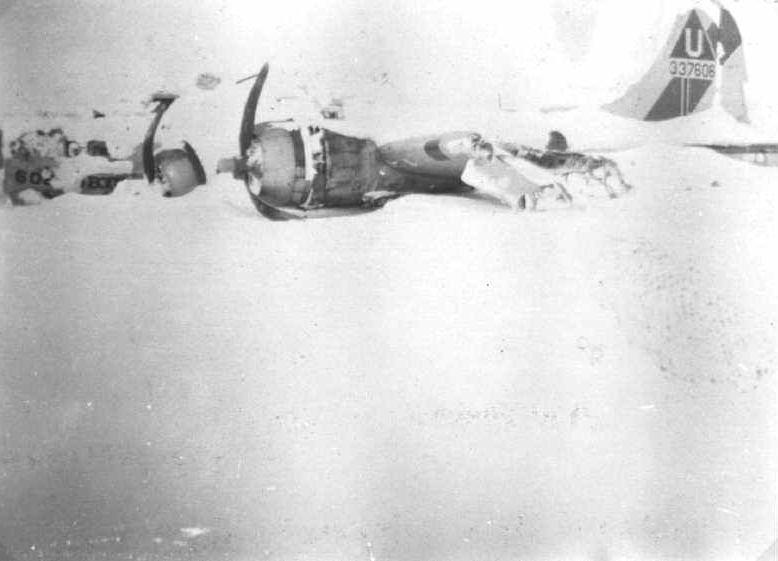
Quelle:
www.457thbombgroup.org
| Allgemein | |
|---|---|
| Hersteller: | Boeing |
| Produktionsblock: | , B-17G-65-BO: 43-37509 bis 43-37673 |
| Ausgeliefert: | Cheyenne |
| Einsatzgeschichte | |
|---|---|
| Bomber-Gruppe: | , 457th Bomb Group |
| Bomber-Staffel: | , 750th Bomb Squadron |
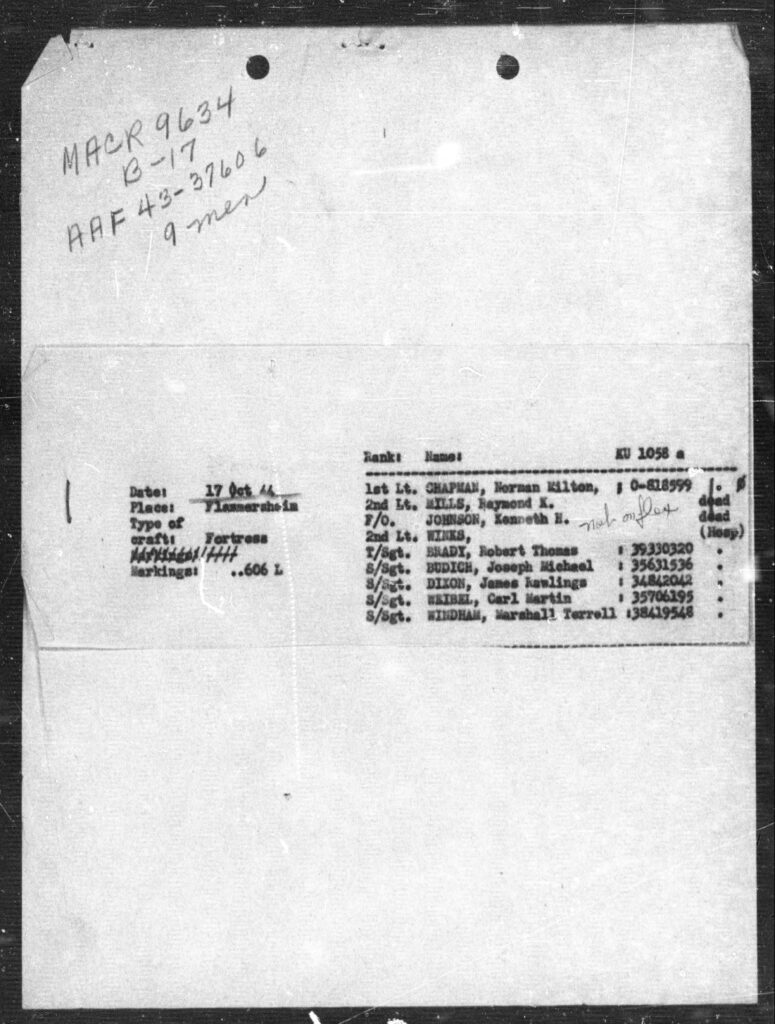
| MACR: | 9634 |
| Deutsches Dokument: | KU-1058A & KU-3119(?) |
| Schicksal: |
, Abschuss durch Flak (17 Oktober 1944) |
Geschichte der
B-17 43-37606 / Big Time Operator
Delivered Cheyenne 4/5/44; Hunter 18/5/44; Dow Fd 4/6/44; Assigned: 750BS/457BG [L] Glatton 7/6/44; MIA Misburg 17/10/44 Pilot: Norman Chapman, Engineer / Top Turret Gunner: Marshall Windham, Radio Operator: Bob Brady, Ball Turret Gunner: Jim Dixon, Waist Gunner: Joe Budich, Tail Gunner: Carl Weibel (6POW); Co-Pilot: Ray Mills, Navigator: Ken Johnson, Bombardier: Oliver Wicks (3KIA); flak, crashed Flammersheim [KU-11058A], Germany [21km south-west of Bonn]. MACR 9634. BIG TIME OPERATOR.
Informationen können Korrekturen und Ergänzungen auf Grundlage von Jings Recherchen enthalten.
B-17 43-37606 / Big Time Operator Details
Mäßiges bis intensives, ziemlich präzises Flakfeuer.
[Flugzeug] Anscheinend von Flak getroffen; je eine Explosion wurde unter jedem Flügel nahe dem Rumpf gemeldet, es wurden jedoch keine Schäden festgestellt.
Das Flugzeug war anscheinend nicht außer Kontrolle. Es vollführte eine scharfe Kurve zurück nach rechts, was die beiden Flügelmänner dazu veranlasste, mitzudrehen, bis sie bemerkten, dass es die Formation verließ.
Das Flugzeug vollführte etwa eine 180-Grad-Kurve und verließ die Formation im Gleitflug. Weder Rauch noch Feuer wurden gesichtet.
Quelle: MACR 9643
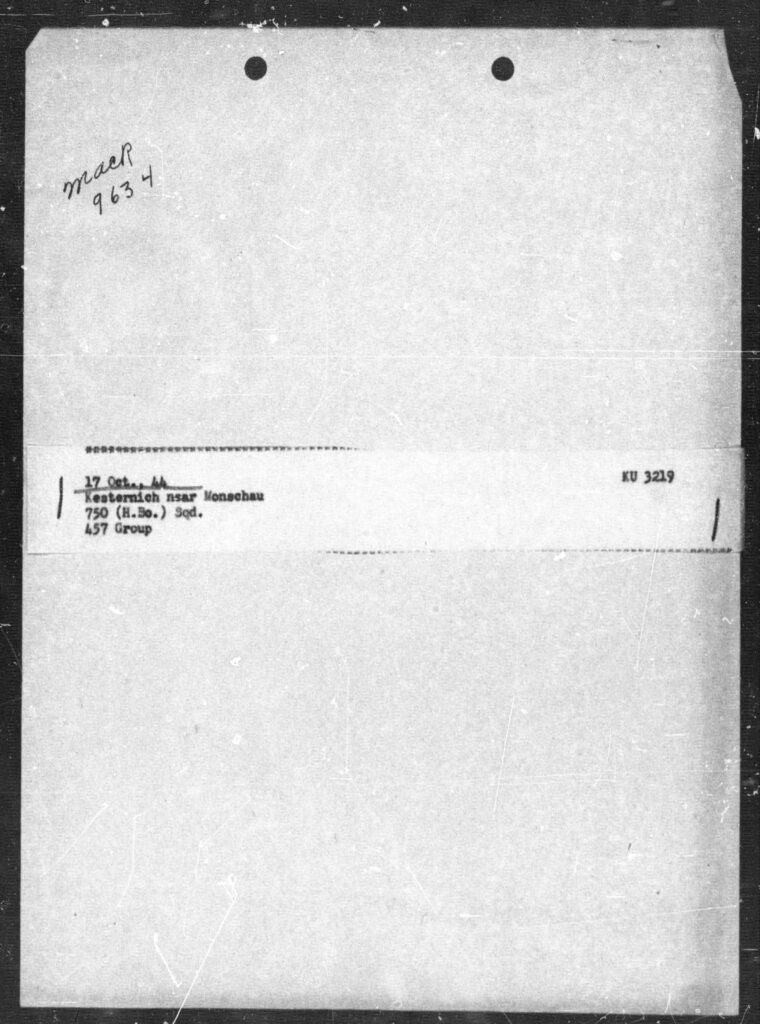
KU-1058A & KU-3219
Zwei Ortsangaben werden in MACR 9634 unter KU-1058A bzw. KU-3219 aufgeführt.
B-17 43-37606 / Big Time Operator Crew
| Position | Rang | Name (Vorname, Initiale, Nachname) | Status | Bemerkung |
|---|---|---|---|---|
| P | 1LT | Norman M. Chapman | POW | - |
| CP | 2LT | Raymond K. Mills, Jr. | KIA | - |
| NAV | F/O | Kenneth H. Johnson | KIA | - |
| BOMB | 2LT | Oliver W. Wicks | KIA | - |
| ENG/TT | S/SGT | Marshall T. Windham | POW | - |
| RO | T/SGT | Robert T. Brady | POW | - |
| BT | S/SGT | James R. Dixon | POW | - |
| WG | SGT | Joseph M. Budlich | POW | - |
| TG | S/SGT | Carl M. Weibel | POW | - |
2.445 Aufrufe
Diese Seite wurde zuletzt am 22. März 2026 aktualisiert


26. Mai 2025 access_time 16:49
The crash site is NOT near Prüm in the southern part of the Eifel, it is Kesternich in the Huertgen Forest (northern part of the Eifel). There are some more pictures of the snow covered aircraft and some summer images of 1946. It even exists a newspaper article from the 2020s dealing with a farmer of Kersternich who used parts of the aircraft in his barn.
M. Cremer, LtCol
18. März 2026 access_time 2:50
I am the son of Kenneth H. Johnson, navigator on BTO. I would love to see more pictures if anyone has their location on the web. I thought the crash site was near Aachen. Any further information would be greatly appreciated.
Kenneth Johnson
18. August 2026 access_time 16:21
Dear Mr. Johnson,
my name is LtCol Mario Cremer, I am a native of the Huertgen Forest area. That region is located west of Aachen in the German-Belgian border region. In the fall of 1944 it was the scene of heavy fightings between the 1st US Army and the troops of the Wehrmacht commanded by Feldmarschall Walter Model. There was also a lot of combat in the air. The worst day of the USAAF was August, 17th, 1943 when several hundred B 17 attacked the Messerschmitt aircraft factory in Regensburg and the ball bearing plant in Schweinfurt. For both targets, the Fortresses had to fly over the Huertgen Forest region. 60 Fortresses were lost on that day and 12 of them crashed in an diameter of 20 miles around the Huertgen Forest. Until May 1945 more than 80 additional allied aircraft crashed in our region – one of them was the B 17-Bomber ,,Big Time Operator“ (BTO), Serialnumber 43-37606, 750th Bomb Squadron, / 457th Bomb Group. It was hit by accurate Flak-fire over Cologne on October, 17th, 1944 and made a crash landing near the town of Kesternich/Huertgen Forest. Had it flown only 5 more minutes, the ship would have crossed the frontlines between the US 9th InfDiv and the German 275th InfDiv and the crew would have been picked safely by American troops and would have been able to fly a new missions for its Squadron in the month of October 1944. But fate was against it. I have a lot of pictures of that ,,case“ but I’m not sure how to provide them to you. Please send me your private e-mail adress and I’ll send you all I have. I’m available via mariocremer@t-online.de
Greetings from Huertgen Forest:
M. Cremer, LtCol (mech Inf)